

These are complex times. Colorado currently faces mounting pressures from climate change, rising costs, and a widening gap between citizens and their government. Problems have been allowed to pile up until answers are no longer simple, but our team has researched Coloradans main concerns and created Solution Areas arranged under the IV Thematic Cornerstones. Below you will find the Cornerstones of our Platform and if you read further, a deep dive into how we will fund and accomplish each of the15 Solution Areas. You will also find our Interstate SkyCarbon Blueprint for sparking the arrest and repair of climate change in the next decade!
PLEASE NOTE: This is extensive, high level material (with lost of bullet points), but we understand you are tired of leadership that sounds good and performs poorly. What you see here is that our campaign is serious about getting work done for YOU. In particular we are the only campaign with the means to begin to stop and reverse climate change - the number one treat to your survival.
If you find a candidate with a more robust, comprehensive, and workable plan for Colorado who also has a science-based, economically feasible strategy to effectively address climate change vote for them. If not welcome aboard!
THE FOUR CORNERSTONES
Cornerstone I: Governance By and For The People Focus: Rebuilding the relationship between the state and the citizen.
-
Item 1: Principles-Based Government
-
Item 2: State Security and Sovereignty
-
Item 3: Budget, Revenue & Long-Term Fiscal Stability
Cornerstone II: Repairing The Living Environment Focus: Protecting the basic physical conditions of life.
-
Item 4: Clean Air, Clean Water, Safe Soils
-
Item 5: Climate Action That Protects Colorado’s Future
Cornerstone III: Economic Sovereignty Focus: Lowering systemic costs and investing in Colorado's future.
-
Item 6: Corporate Accountability & Economic Fair Play
-
Item 7: Lower Cost of Living & Better Jobs
-
Item 8: Real Solutions to the Housing Crisis
-
Item 9: High-Quality, Affordable Healthcare for Every Coloradan
Cornerstone IV: Restoring the Social Fabric Focus: Strengthening the "Neighborly" bonds of the community.
-
Item 10: Homelessness: Housing + Health, Not Chaos
-
Item 11: Public Safety: The Standard for Compassion & Protection
-
Item 12: Immigration & Integration: The Path to Shared Contribution
-
Item 13: Education & Human Development
-
Item 14: Equal Dignity, Inclusion & Access
-
Item 15: Veterans, Service Members & Military Families
CORNERSTONE I: GOVERNANCE BY AND FOR THE PEOPLE
1. Principles-Based Government That Works for the People We will rebuild trust by making government predictable, transparent, and accountable. By shifting away from decisions made behind closed doors, this administration will show its work and invite residents back into the shared project of self-government. This pillar ensures that every state decision is grounded in core principles like equal dignity, intergenerational responsibility, and environmental rights. It moves the state away from arbitrary or politically motivated decision-making. Following the Constitution, every decision will be grounded in core American principles:
-
Ethics Transparency: Establish stricter conflict-of-interest and lobbyist disclosure rules for all state officials.
-
Daily Citizen Dashboard: A statewide platform where residents can vote on priorities, submit ideas, and track their influence on decisions.
-
Citizen Juries: Representative groups of Coloradans who deliberate on complex issues like water policy and land use.
-
Weekly Public Briefings: “State of the State” explanations of major decisions.
-
A Real-Time Public Input System: Built by the Office of Information Technology
-
Intergenerational Election Reform: Hard limits on big influencers.
-
Principles-First Framework: All major agency actions must be mapped to core values and explained in public memos.
-
Legacy Impact Scoring: Evaluate long-term policies (like infrastructure or water) based on their impact on future generations.
-
Rotating Oversight Bodies: Utilize diverse citizen assemblies and youth councils to prevent the consolidation of power.
This is not theory — these are administrative actions that begin on Day One guiding actual decisions, not just speeches.
2. Protecting Colorado’s Security and Sovereignty We will strengthen the systems that keep Colorado safe. Colorado will act as a co-sovereign state that protects its autonomy, infrastructure, and residents from external interference or federal overreach. This pillar builds "quiet strength" through sophisticated, non-partisan defense of state authority.
-
Codify Non-Commandeering: Mitigating federal "conscription" of state employees for federal civil priorities.
-
Sovereignty Review of Grants: Review federal agreements to ensure sensitive resident data is not shared without warrants.
-
Quarterly Cybersecurity penetration tests: Cybersecurity upgrades and unannounced tests on county election systems and rural water districts.
-
Bipartisan Civil Liberties Board: Create an oversight board to review Guard deployments, upgrades and advanced technologies.
-
Preparing for future threats both foreign and domestic.
-
Increased Infrastructure Protection and faster, more coordinated emergency response
-
Elite State Security: We will launch a premier Colorado State Security Force by offering a $50,000 "Transition Grant" to recruit federal agents into state service, poaching federal talent to serve as dedicated Colorado assets.
-
Sovereignty & Trust: By enforcing a "State Sovereignty Firewall" under SB25-276, we will end federal civil overreach and replace administrative chaos with a "Good Neighbor" model that prioritizes community peace and constitutional integrity.
-
Scientific Stewardship: This strategic realignment shifts our resources from federal enforcement to Colorado’s true priorities: defending our water rights, lowering the cost of living, and leading the SkyCarbon Frontier to secure our atmospheric future.
3. Budget, Revenue & Long-Term Fiscal Stability In a state limited by TABOR can these much-needed upgrades to Colorado be achieved. Yes! Under Governor Komor we will stabilize Colorado's finances through "Economic Sovereignty"—building state-owned assets. We will focus on closing loopholes and making creative investments to fund priorities like mental health. Most importantly, we will aggressively expand "Government-Owned Enterprises," such as the Colorado Infrastructure Bank and the SkyCarbon Enterprise. Because these entities are funded by fees for services (like carbon sequestration leases or interest on infrastructure loans) and receive less than 10% of their revenue from state grants, they are constitutionally exempt from TABOR limits. This creates a "sovereign wealth" loop that funds major priorities without triggering tax-increase requirements.
-
Colorado Public Investment Fund (CPIF): Generate revenue by taking equity stakes in Colorado-based startups, particularly in energy and tech.
-
Close "Unitary Business" Loopholes: Prevent corporations from shifting profits to low-tax states to ensure they pay their fair share.
-
TABOR Smoothing for Mental Health: Refer a measure to voters allowing the state to retain revenue specifically for fentanyl and mental health treatment.
-
Modernize State Land Leasing: Shift state land use from "spending" to "investing" by leasing pore space for carbon sequestration.
-
Building state-owned assets that generate long-term revenue. Every element of society paying its fair share.
CORNERSTONE II: REPAIRING THE LIVING ENVIRONMENT
4. Clean Air, Clean Water, Safe Soils Colorado will enforce environmental standards with the same seriousness we apply to public safety. We will focus on zero-tolerance monitoring and holding polluters directly accountable for restoration. The fracking debacle that happened under the watch of our opponents and now threatens the health and safety of vast numbers of Coloradans will not be allowed to happen again.
-
Establish the Colorado Environmental Protection Agency (CEPA): Consolidating fragmented oversight from multiple agencies into one unified enforcement body. (Discussion: The Governor cannot unilaterally create a new principal department because the Administrative Organization Act of 1968 requires statutory authorization for such a shift. To solve this we will launch the "Executive Science Initiative", or “Executive Consolidation Directive” on Day One. This uses the Governor’s power to reorganize functions within the executive branch to create a "virtual" CEPA through a Binding Memorandum of Understanding (MOU) between the DNR, ECMC, and CDPHE. This MOU will mandate that these agencies operate under a unified leadership council and shared monitoring data immediately, while the formal "Department Reorganization Act" moves through the legislature. By designating a single Science & Enforcement Lead to oversee concurrent divisions across these agencies and unifying their data streams into the Zero-Tolerance Monitoring System, the we can n achieve the operational goals of a unified agency on Day One without waiting for legislative restructuring.)
-
Zero-Tolerance Monitoring: Deploy a statewide IoT sensor array for real-time air and water monitoring with a public dashboard.
-
Mandatory Cleanup Timelines: Implement the "If you make a mess, you clean it up" doctrine with tough consequences for violators. (Discussion: Granting the state authority to place liens on the personal assets of corporate executives requires new statutory authority that is legally complex. The immediate solution is the "Remediation Surety Bond Mandate." Using existing regulatory authority over industrial permits, the administration can require that companies in high-impact sectors (mining, energy) fund a Remediation Surety Bond upfront as a condition of their permit. This ensures the cleanup funds are secured and legally "air-gapped" from the corporation's internal finances, achieving the goal of the "Colorado Cleanup Doctrine" without needing to wait for a change in personal liability laws.)
-
Colorado Stewardship Corps: A protection program dedicated to wildfire mitigation, habitat restoration, and trail maintenance. Strong protection for wildlife, water, and land.
-
Wildfire Prevention And Rapid-Response Systems
-
Climate science integrated into every major decision
-
Water security and drought resilience. A hydrologic trigger mandate - automatically reduce water deliveries to lower-basin states if reservoir levels drop below critical safety tiers.
-
"Sponge Landscape" Initiative: Restore 500 miles of wetlands to serve as natural wildfire buffers and water storage.
-
Carbon-Negative Infrastructure: Mandate the use of captured carbon in concrete for all state highway projects by 2027.
-
This is environmental stewardship, not limp rhetoric.
5. Climate Action That Protects Colorado’s Future In the Paris Accords governments stated we must keep global warming below 1.5C. Currently we are at 1.4C! Atmospheric levels have risen from 416.1 ppm in 2021 to 428.5 in 2026 – an increase of 3.75 ppm yearly placing us on track to cross the 450 ppm tipping threshold within a decade. Once crossed, Earth’s systems historically have reorganized irreversibly, leading to Epochal collapse and reformation of environmental systems and, in this case, human infrastructure. In prior instances of 450 ppm breach, more than half of plant and animal species became extinct. Climatologists have been terrified about a lot of things but mostly about the effects of melting glaciers and mostly about their effect on heat transporting ocean currents or AMOC currents. Can you guess what happens when ocean currents stop moving heat around the globe. Well all these feedbacks in natural systems are piling up faster than any of the scientists expected. No time to solar transitions, no time for sandbags, no time for electric cars.
-
Direct Atmospheric Carbon Removal (DACR) is now the only scalable technology capable of removing legacy carbon and restoring atmospheric balance.
-
As Governor, I will create DACR Innovation Hubs, building out the technology for Direct Atmospheric Carbon Removal in such a way that Colorado ultimately profits from the construction and from the reclamation.
CORNERSTONE III: ECONOMIC SOVEREIGNTY
6. Corporate Accountability & Economic Fair Play This Operational Area rewards "good actors" who invest in Colorado while holding "bad actors" accountable for broken promises or environmental damage. It promotes a fair-market system where corporations have no special rights above the public interest. This is fair-market governance, not anti-business rhetoric.
-
Incentives for companies that invest in Colorado
-
Mandatory Incentive Clawbacks: Require corporations to pay back state tax credits if they fail to meet wage or job targets.
-
Employee Ownership Incentives: Offer tax credits for businesses transitioning to ESOPs or cooperatives.
-
"Living Wage" Procurement Preference: Award a 20% preference on state contracts to bidders paying 110% of the local median wage.
-
Colorado Cleanup Doctrine: Aggressively enforce "If you make a mess, you clean it up" for corporate polluters. Tough consequences for polluters and promise-breakers.
7. Lower Cost of Living & Better Jobs We will use state tools to reduce costs and expand opportunity and address the fact that 9 in 10 Coloradans see the cost of living as a serious problem. This pillar uses state tools to lower bills and expand high-wage opportunities. It treats affordability as a systemic issue involving housing, healthcare, and wages.
-
Accelerated housing construction (Discussion: Municipalities are likely to litigate against state-level zoning overrides, citing Colorado’s robust "Home Rule" constitutional protections. We will redefine housing production as a "Matter of Statewide Concern," a legal threshold that allows state law to supersede local ordinances. Instead of a blunt mandate, the administration will utilize the "Infrastructure-Tied Funding" model. By conditioning discretionary state grants for water, transportation, and broadband on local compliance with housing targets, the state exerts financial "soft power" that bypasses the legal risks of a direct zoning mandate.)
-
Lower healthcare costs: through transparency and competition
-
Support for small businesses and rural economies
-
Lower Systemic Costs: Utilize state authority to reduce bills for housing, healthcare, and insurance.
-
High-Wage Training Pipelines: Create direct paths to jobs in clean energy, water tech, and skilled trades.
-
Labor Enforcement Coordination Council: Coordinate across agencies to aggressively protect worker rights and safety.
-
Statewide Wage Growth: Incentivize companies to pay at least 110% of the local median wage.
8. Real Solutions to the Housing Crisis This "production-first" strategy targets the structural shortage of homes by overriding restrictive zoning and fast-tracking construction. It focuses on building enough homes at prices people can afford while protecting renters from speculative price spikes.
-
Build housing on state-owned land.
-
Acquire Speculative Buildings: The state will buy buildings before they flip to out-of-state investors to keep them affordable.
-
Targeted renter protections that stabilize families.
-
Infrastructure-Tied Funding: Tie state funding for water and transportation to local compliance with housing targets.
-
Faster, simpler building rules that cut months off construction timelines.
-
Override Exclusionary Zoning: Require "by-right" multifamily and "missing middle" housing in areas rich with jobs and transit.
9. High-Quality, Affordable Healthcare for Every Coloradan We will make healthcare simpler, cheaper, and more reliable. This pillar creates a practical "Health Security Covenant" to ensure healthcare is simpler, cheaper, and more reliable. It builds a state-level system that shields Coloradans from federal volatility while expanding access for children and seniors.
-
Automatic enrollment for children
-
Lower drug and hospital costs through transparency and negotiation
-
Universal Baseline Coverage: Implement an automatic enrollment system for all children and universal essential care.
-
Strengthen the "Colorado Option": Make the state-run plan the default for those without employer-sponsored coverage.
-
Transparent Price Negotiation: Use radical transparency to lower drug and hospital costs through direct negotiation.
-
Dignity in Aging: Expand support for seniors to age safely at home with increased home-care provider pipelines.
-
(Discussion: GO: The Senior Care "Bridge" Pipeline (Workforce Shortages) A critical shortage of home-care aides and primary care providers threatens the "Dignity in Aging" mandate, which aims to help seniors age at home. The solution is the "Senior Health Security Covenant" Tuition-Swap. Under this program, the state will provide full tuition reimbursement for any student entering a certified nursing assistant (CNA) or home health aide program who commits to a two-year service contract in a rural or high-need Colorado community. By utilizing 1115 Medicaid Waiver funds to cover these training costs, the state can rapidly expand the provider pipeline without requiring a new legislative appropriation.)
CORNERSTONE IV: RESTORING THE SOCIAL FABRIC
10. Homelessness: Housing + Health, Not Chaos We will replace the current patchwork with a coordinated, health-led "Housing First" system. It emphasizes that jails and ERs are not mental health policy, focusing instead on permanent supportive housing with embedded services.
-
ACT Teams: Expand Assertive Community Treatment teams to bring counseling and psychiatric care directly to residents. Crisis teams instead of jail or ER cycles.
-
No Discharge to Homelessness: Ensure that no one is released from a hospital, jail, or foster care onto the street.
-
Supportive Housing & Recovery Fund: Consolidate fragmented funding into a single, results-based stream for local initiatives. Housing First with real behavioral-health support.
-
Public Order + Compassion: Enforce public space standards only when paired with a credible, immediate offer of shelter and treatment.
-
Prevention programs: that keep people from falling into homelessness.
11. Public Safety: The Standard for Compassion & Protection Colorado’s peace is built on the twin pillars of strength and service. Our goal is to empower law enforcement to ‘Speak Softly and Carry a Big Stick’—ensuring the power of the state is felt through its helpfulness, while its strength remains a predictable and swift deterrent to those who harm the public.
-
The Good Neighbor Initiative: Transition from a "Citation-First" culture to a "Service-First" model. We will implement Neighborly Performance Metrics (NPMs) where departments receive state grants based on "Service Actions"—such as helping a stranded motorist, securing a neighborhood after a storm, or de-escalating a mental health crisis—rather than ticket quotas.
-
The "Big Stick" Doctrine: Provide our officers with the most advanced protective equipment and technical training in the nation. When a crime occurs, the response must be swift and technically superior. We fund the tools for safety, so the attitude can remain neighborly.
-
The Professionalization Fund: Increased state funding specifically for "Civilian-Adjacent" training—equipping officers with the tools to act as community problem-solvers while maintaining a 24/7 posture of high-readiness for public defense.
-
Transparency & Misinformation Dashboard: A public, real-time portal to debunk false claims regarding public security, ensuring the community has a "Single Source of Truth" during times of high tension.
12. Immigration & Integration: The Path to Shared Contribution We address immigration with the same calm predictability we apply to our industry. Colorado is a state of laws and a state of neighbors; we expect contribution and provide a clear, fair pathway for those who wish to build a future here.
-
Office of New Americans (ONA) Hub: Centralizing all immigration integration into a high-efficiency "Front Door" for the state. This hub provides emergency navigation, legal clarity, and workforce placement.
-
Linguistic Integration & Expectations: We will expand the Career-Aligned English program. Integration is a "Two-Way Street"; we provide the resources for English fluency and civic education, and we expect newcomers to utilize them as a prerequisite for full participation in our economy.
-
Entanglement Protections: To maintain the "Neighborly" trust in local law enforcement, we reaffirm that state and local resources will not be used for federal civil immigration enforcement. Our police are here to protect the community, not to act as administrative agents for the federal government.
-
From Grievance to Contribution: We focus on matching "New American" talent with our growing SkyCarbon Frontier and industrial needs, turning a partisan flashpoint into a shared economic engine.
13. Education & Human Development This pillar focuses on professionalizing public education and supporting the "whole child" without engaging in divisive culture wars. It prioritizes teacher pay and life-skills alongside core academics to prepare students for the next century.
-
Nation-Leading Teacher Pay: Implement a professional salary scale to attract and keep top educators in Colorado schools.
-
Universal Early Childhood Access: Ensure every child in the state has access to high-quality early learning.
-
Prohibit Private School Vouchers: Ensure public education funds remain in public schools to benefit all students.
-
Curriculum Reform: Integrate civics, ethics, mental health, and environmental education into the standard curriculum.
This is a professionalization of education, not a culture war.
14. Equal Dignity, Inclusion & Access The administration will protect equal opportunity and inclusion based on dignity and safety rather than ideology. It focuses on removing barriers for all residents, particularly those with disabilities, to ensure full participation in state life.
-
Expand Youth Counseling: Significantly increase the number of school counselors and adolescent identity support.
-
Support for teens without politicization.
-
Disability Inclusion Enforcement: Strengthen and enforce access standards across all state-funded services and infrastructure.
-
"Inclusion Without Ideology" Standards: Set statewide standards that frame inclusion as dignity, safety, and opportunity.
-
Public Inclusion Dashboards: Track and report on accessibility and workforce inclusion progress statewide.
15. Veterans, Service Members & Military Families We will honor service with real support. Colorado will honor service with practical, veteran-reported support rather than just slogans. This pillar integrates veterans into the state’s workforce and ensures their families have a stable, affordable life.
-
Expanded Peer Support: Strengthen mental health and family stability services led by those who understand the military experience.
-
Lower cost of living.
-
Veteran Job Pipelines: Launch programs that recognize military skill sets for high-wage state and private sector roles.
-
No Homeless Veterans: A state guarantee that every veteran in Colorado will have access to stable housing.
-
Military Cost of Living Relief: Targeted support to ensure military families are not priced out of the communities they serve.
The Bottom Line
Every item in the Komor for Governor plan is tied to:
-
real authority
-
real timelines
-
real agencies
-
real implementation
State of the Campaign


Colorado doesn’t need more promises. Colorado needs a Governor who will do the work you asked for. This plan is how we do it.
TABLE OF CONTENTS
OPERATIONS SECTION
Area 1. Responsive, Trustworthy Government Directed by the Citizens of Colorado
1.1 Crisis of Trust & Democratic Integrity 1.2 Citizen Input Infrastructure 1.3 Principles-First Governance 1.4 Civic Participation & Community Identity 1.5 Reducing Polarization & Increasing Predictability 1.6 A Human-Centered Governor’s Office
Area 2. Environmental Stability, Protection & Conservation
2.1 Foundational Principles 2.2 Colorado Environmental Protection Agency (CEPA) 2.3 Zero-Tolerance Monitoring System 2.4 Enforcement Framework 2.5 Air Protection 2.6 Water Protection 2.7 Soil Protection 2.8 Wildlife, Habitat & Land Conservation 2.9 Conservation Funding 2.10 Environmental Justice & Community Protection 2.11 Civic Stewardship
Area 3. Economic Stability & Opportunity
3.1 Core Goals 3.2 Housing Affordability & Stability 3.3 Healthcare Affordability 3.4 Jobs, Wages & Economic Security 3.5 Cost of Living: A Whole-System Approach 3.6 Opportunity & Mobility 3.7 Governing Doctrine
Area 4. Affordable Housing
4.1 Root Problem: Not Enough Homes 4.2 Build & Acquire Permanent Affordable Housing 4.3 Property Tax & Speculation Reform 4.4 Targeted Rent Regulation 4.5 Construction Costs & Timelines 4.6 Support for Low- and Middle-Income Renters 4.7 U.S. Lessons 4.8 International Lessons 4.9 What to Imitate & Avoid 4.10 Hard Truths
Area 5. Homelessness & Behavioral Health
5.1 Core Stance 5.2 Housing First + Services 5.3 Permanent Supportive Housing 5.4 ACT Teams 5.5 Coordinated Entry & Crisis Response 5.6 Prevention 5.7 Mental Illness & Addiction as Health Issues 5.8 Public Order + Compassion 5.9 Funding & Structure 5.10 Narrative
Area 6. High-Quality, Affordable Healthcare for Everyone
6.1 Core Principles 6.2 Universal Coverage Architecture 6.3 Medicaid Backbone 6.4 Strengthening the Colorado Option 6.5 Public Backstop 6.6 Continuous Coverage 6.7 Cost Control Through Science 6.8 Senior Care 6.9 Shielding Colorado from Federal Volatility 6.10 Navigation
Area 7. Immigration, Public Safety & Polarization
7.1 Voter Concerns 7.2 Humane Immigration Framework 7.3 Voting Safety as Public Safety 7.4 Public Safety Without Partisanship 7.5 Reducing Polarization
Area 8. Climate Change & Colorado’s Future
8.1 Climate Risk 8.2 Colorado as a DACR Hub 8.3 Water Security 8.4 Climate Integration Across Government
Area 9. Principles-Based Governance (“Self-Evident Truths”)
9.1 Foundational Principles 9.2 OPERATIONSizing Principles 9.3 Decision Framework 9.4 Transparency & Public Reason-Giving 9.5 Ethical Guardrails
Area 10. Respectful & Mutually Beneficial Federal Relations
10.1 Colorado’s Role 10.2 Cooperative Federalism 10.3 Protecting State Autonomy 10.4 Federal Funding Strategy 10.5 Multi-State Compacts
Area 11. Education & Human Development
11.1 Foundational Principles 11.2 Public Education Doctrine 11.3 Curriculum Reform 11.3.1 Early Childhood Access 11.4 School Safety Doctrine 11.5 Teacher Pay & Professionalization 11.6 Governance & Oversight 11.7 Narrative
Area 12. Equal Dignity, Inclusion & Access (DEI)
12.1 Foundational Principles 12.2 Disability Inclusion 12.3 Inclusion Without Ideology 12.4 Adolescent Identity Development 12.5 Self-Health Curriculum 12.6 Counseling Expansion 12.7 Workforce Inclusion 12.8 Narrative
Area 13. Veterans, Service Members & Military Families
13.1 Foundational Principles 13.2 Cost of Living Relief 13.3 Election Integrity & Civic Participation 13.4 Public Safety & Stability 13.5 Employment & Skills 13.6 Mental Health & Family Stability 13.7 Housing Stability 13.8 Narrative
Area 14. Corporate Accountability & Economic Fair Play
14.1 Foundational Principles 14.1.1 Human-Centered Governance Principle 14.2 Incentives (“The Carrot”) 14.3 Enforcement (“The Stick”) 14.3.1 Colorado Cleanup Doctrine 14.4 Shielding Colorado from Corporate Leverage 14.5 Why Corporations Stay 14.6 Colorado Corporate Compact 14.7 Narrative
Area 15. Budget, Revenue & Long-Term Fiscal Stability
15.1 Fiscal Principles 15.2 Modern Revenue Architecture 15.3 Closing Loopholes 15.4 Long-Term Stability 15.5 Economic Sovereignty
OPERATIONS AREA 1:
RESPONSIVE, TRUSTWORTHY GOVERNMENT DIRECTED BY THE CITIZENS OF COLORADO
Colorado voters are frustrated. They see polarization, dysfunction, and a political system that feels distant and unresponsive. Many believe government is a black box — decisions made behind closed doors, influenced by special interests rather than citizens. This OPERATIONS Area lays out a structural fix: a government that is transparent, predictable, principled, and continuously shaped by the people it serves.
1.1 Crisis of Trust & Democratic Integrity
Colorado voters consistently express:
-
Distrust of both major parties
-
Fear of political violence
-
Concern about polarization
-
Desire for civility, integrity, and transparency
Many Coloradans believe people in the state have more in common than what divides them — but they don’t see that reflected in politics.
A trustworthy government must:
-
Show its work
-
Explain its decisions
-
Invite participation
-
Operate predictably
-
Resist special-interest capture
This plan builds those structures.
1.2 Citizen Input Infrastructure
Real-Time Citizen Dashboard
A permanent, statewide platform where residents can:
-
Vote on priorities
-
Submit ideas
-
Track how their input influences decisions
-
See weekly summaries of rising and falling issues
Colorado Civic Input Office
A new institution that:
-
Manages the dashboard
-
Publishes weekly reports
-
Tracks citizen submissions
-
Ensures input is integrated into agency decisions
Public Cabinet Meetings
Weekly cabinet-level briefings open to the public — not performative town halls, but real governance sessions.
Citizen Juries
Randomly selected, demographically representative groups that deliberate on:
-
Water policy
-
Housing
-
Public safety
-
Land use
Used successfully in Ireland, France, and Canada.
1.3 Principles-First Governance
People distrust government when decisions feel arbitrary or politically motivated. You counter that by publishing a Principles-First Framework:
-
Equal right to breathable air
-
Equal right to drinkable water
-
Equal right to safe soils
-
Equal right to safety
-
Equal right to opportunity
-
Equal right to dignity
Every major decision is explained through this lens.
“Why We Made This Decision” Memos
Agencies must publish plain-language explanations for major actions:
-
What citizens said
-
What the science showed
-
How principles guided the decision
1.4 Civic Participation & Community Identity
Colorado has unusually high civic potential — people love their land, their communities, and their sense of place.
Colorado Civic Corps
A voluntary service program for:
-
Wildfire mitigation
-
Water conservation
-
Trail maintenance
-
Community health
-
Senior support
Service builds unity faster than rhetoric.
Governor’s Awards for Citizen Problem-Solving
Recognizing residents who improve their communities.
Micro-Grants for Local Projects
$500–$5,000 grants for neighborhood-level solutions.
1.5 Reducing Polarization & Increasing Predictability
Polarization grows when people feel unsafe or uncertain.
Voting Safety as Public Safety
Secure, transparent, predictable elections reduce fear.
Statewide Risk Map
A public map showing:
-
Climate risks
-
Water risks
-
Economic risks
-
Infrastructure risks
-
Public health risks
When people understand risks, they stop imagining conspiracies.
Misinformation Transparency Dashboard
Shows:
-
Viral false claims
-
Their origin
-
Verified facts
1.6 A Human-Centered Governor’s Office
Leadership sets the tone.
A governor can:
-
Hold calm, factual weekly briefings
-
Avoid inflammatory language
-
Treat opponents as legitimate participants in democracy
-
Praise bipartisan cooperation
-
Visit every county annually
-
Hold open office hours
-
Bring cabinet meetings to rural towns
-
Use storytelling to connect policy to real lives
1.7 Election Reform, Democratic Stewardship, Election Integrity, and Intergenerational Representation
Colorado’s democracy is strongest when it is transparent, participatory, and accountable to both present and future generations. The Komor for Governor administration will strengthen the foundations of democratic governance by expanding citizen participation, improving transparency, and ensuring that long-term decisions reflect long-term consequences. This OPERATIONS Area focuses on trust, access, resilience, and stewardship — the pillars of a healthy democratic system.
Strengthening Transparency and Public Understanding
Coloradans deserve a clear view into how elections work and how decisions are made. The administration will expand public visibility into election processes and government operations through:
-
Public education on election processes, including ballot handling, audits, and chain-of-custody procedures.
-
User-friendly access to election data, enabling citizens to track turnout, ballot processing, and audit results.
-
Improved communication between county clerks and the public, ensuring consistent, accessible information statewide.
This aligns with the Komor for Governor commitment to a government that shows its work.
Supporting County Clerks and Local Election Staff
Colorado’s 64 counties administer elections, and many face staffing, training, and resource challenges. The administration will support them through:
-
Modernized equipment and secure infrastructure
-
Enhanced training and professional development
-
Stable, predictable funding for election administration
-
Cybersecurity upgrades and statewide threat-coordination
-
Improved physical security for election workers
This reinforces the principle of competent, principled administration.
Expanding Access and Participation
Colorado already has high voter turnout, but participation can be strengthened further by ensuring equitable access across geography, ability, and language.
The administration will focus on:
-
Improved access for rural voters
-
Expanded services for voters with disabilities
-
Enhanced language access and multilingual materials
-
Strengthened ballot-drop infrastructure in underserved areas
This reflects the Komor for Governor commitment to equal dignity and opportunity.
Reinforcing Security and Resilience
Election security is essential to public trust. The administration will reinforce resilience through:
-
Continued investment in cybersecurity
-
Strengthened risk-limiting audits
-
Improved physical security at voting centers
-
Statewide coordination on threats, misinformation, and emergency response
This supports the broader Komor for Governor theme of stability and preparedness.
Improving the Voter Experience
A healthy democracy depends on a voting process that is accessible, predictable, and user-friendly.
The administration will:
-
Reduce wait times and streamline in-person voting
-
Improve ballot-tracking tools
-
Simplify voter-information materials
-
Enhance customer-service training for election staff
This reinforces the principle of citizen-directed government.
Intergenerational Representation
Colorado’s long-term decisions must reflect long-term consequences. To ensure that future generations have a voice in today’s policymaking, the administration will establish:
-
Youth Councils and Future-Generation Advocates with formal roles in reviewing major policy proposals.
-
Legacy Impact Scoring for long-term policies — including environmental, infrastructure, and fiscal decisions — to evaluate consequences for future Coloradans.
-
Guardrails Against Short-Termism, ensuring that policies are evaluated not only for immediate benefits but for their long-term effects on land, water, air, and community stability. Unfortunatly, The goal of placing "hard limits" on big influencers through Intergenerational Election Reform cannot be successfully pursued as a direct executive action. While the Governor can propose a State Elections Trust to provide equal funding, the U.S. Supreme Court's established precedents on political speech and campaign finance (e.g., Citizens United) severely limit the state’s ability to restrict "influencer" spending. Pursuing this via executive decree or state-only law would likely lead to an immediate and costly defeat in federal court. This goal should be shifted to a Long-Term Policy Study led by Citizen Juries to build a national-level case for constitutional reform rather than active state enforcement.)
Safeguards Against Abuse and Concentration of Power
A resilient democracy requires checks that are transparent, distributed, and resistant to entrenchment.
The administration will implement:
-
Multi-Layered Checks so no single group or office can unilaterally declare leadership incapacity or make major governance decisions.
-
Transparency Dashboards providing public visibility into oversight processes and relevant monitoring data.
-
Rotating Oversight Bodies, including citizen assemblies and youth councils, to prevent consolidation of influence and ensure broad representation.
-
State Elections Trust, derived from tax dollars and blind donations which provides equal funding for each candidate with strict prohibition against and monitoring of self or special interest funding.
These safeguards ensure accountability that is shared, transparent, and resistant to manipulation.
Transparency and Accountability Mechanisms
Trust grows when the public can see who is influencing decisions and how those decisions are made.
The administration will strengthen transparency through:
-
Corporate Impact Audits, mandating annual public evaluations of major corporations’ environmental, social, and democratic impacts by independent bodies.
-
Open Data for Public Oversight, expanding user-friendly portals that allow Coloradans to track spending, rulemaking, and implementation progress across agencies.
This reinforces the Komor for Governor commitment to government that listens and government that shows its work.
Citizen-Directed Governance
This section ties directly to the Komor for Governor philosophy: a government that is participatory, transparent, and accountable.
The administration will establish:
-
Structured Citizen Assemblies that provide input on major policy areas and help guide long-term planning.
-
Continuous Feedback Channels for Coloradans to submit ideas, concerns, and evaluations of government performance.
-
Public Reporting Rituals, where agencies provide regular, predictable updates on progress, setbacks, and next steps.
This creates a democratic system that is transparent, resilient, and accountable to both present and future generations.
AUTHORITY
This consolidated Authority and Operational Blueprint for OPERATIONS AREA 1 integrates foundational principles with the specific gubernatorial powers required to execute them. It ensures that every action is anchored in the Colorado Constitution and state statutes, leaving no ambiguity for agency heads or legal challengers. This area establishes the "Colorado Transparency Doctrine." It transitions the state from a "black box" bureaucracy to a "Glass House" administration where every executive action is explained, justified, and open to real-time citizen feedback including aggressive expansion of "Government-Owned Enterprises," such as the Colorado Infrastructure Bank and the SkyCarbon Enterprise. Because these entities are funded by fees for services (like carbon sequestration leases or interest on infrastructure loans) and receive less than 10% of their revenue from state grants, they are constitutionally exempt from TABOR limits. This creates a "sovereign wealth" loop that funds major priorities without triggering tax-increase requirements.
1.1 Gubernatorial Authority Matrix: Summary
Category
Unified Details
Predicted Success
Very High. Most actions fall under executive communication, transparency, and internal administrative direction.
Primary Agencies
Governor’s Office, OIT, Dept. of State, Dept. of Public Safety, DNR, CDPHE, and all Executive Cabinet agencies.
Authority Source
CO Constitution Art. IV §2 (Supreme Executive Power); Art. IV §8 (Messages to Legislature); CRS 24-37.5 (OIT Authority); CRS 24-33.5 (Public Safety/DHSEM).
Legislative Role
Minimal. Only required for new permanent statutory offices or large-scale technological funding.

1.2 Pillar I: Crisis of Trust & Principles-First Governance
Objective: Restore democratic integrity through radical, evidence-based transparency.
-
Executive Action 1.1.1: Weekly Public Briefings. The Governor will explain major decisions directly to the public to set the tone for the administration. [Authority: Art. IV §8]
-
Executive Action 1.1.2: Mandatory Decision Memos. Every executive agency is directed to publish “Why We Made This Decision” memos for major rulemakings, citing scientific evidence and citizen input. [Authority: Art. IV §2]
-
Executive Action 1.1.3: Principles-First Executive Order. Establishes predictable, statewide communication and decision-making standards across the executive branch. [Authority: EO Power]
-
Executive Action 1.1.4: Trust & Integrity Working Groups. Convene interagency bodies to identify and eliminate bureaucratic opacity. [Authority: Admin Direction]
-
Executive Action 1.1.5: OIT Transparency Upgrades. Direct OIT to build public-facing tools for tracking state performance and spending. [Authority: CRS 24-37.5]
1.3 Pillar II: Citizen Input Infrastructure
Objective: Create a permanent, real-time "operating system" for public participation.
-
Executive Action 1.2.1: The Colorado Civic Input Office. Establish via Executive Order to manage advisory "Citizen Juries" and feedback loops. [Authority: EO Power/Budgetary Authority]
-
Executive Action 1.2.2: Real-Time Citizen Dashboard. OIT-built interface to allow Coloradans to provide input on pending policy memos. [Authority: CRS 24-37.5]
-
Executive Action 1.2.3: Weekly Public Cabinet Meetings. The Cabinet will rotate meetings through rural and urban communities to reduce the "Capitol Bubble." [Authority: Art. IV §2]
1.4 Pillar III: Civic Participation & Community Identity
Objective: Foster a shared Colorado identity through service and local problem-solving.
-
Executive Action 1.3.1: The Colorado Civic Corps. A statewide service initiative focusing on disaster relief, infrastructure, and community health. [Authority: Art. IV §2/DNR/CDPHE]
-
Executive Action 1.3.2: Governor’s Awards for Problem-Solving. Launch high-visibility awards for citizens who solve community issues through local action. [Authority: EO Power]
-
Executive Action 1.3.3: Community Micro-Grants. Direct agencies to offer small-scale funding for local citizen-led projects. [Authority: Agency Budgetary Authority]
1.5 Pillar IV: Elections Reform & Polarization Reduction
Objective: Shield the democratic process from misinformation and increase system predictability.
-
Executive Action 1.4.1: Misinformation Transparency Dashboard. A public portal to track and debunk coordinated disinformation targeting state safety or election systems. [Authority: CRS 24-37.5]
-
Executive Action 1.4.2: Statewide Risk Map. Publish annual data-driven maps on climate, economic, and safety risks to improve public predictability. [Authority: Art. IV §2/OIT]
-
Executive Action 1.4.3: Election Infrastructure Support. While the Sec. of State is independent, the Governor uses Budgetary Power to fund cybersecurity upgrades, support county clerks, and modernize equipment. [Authority: Budgetary Authority/Admin Rulemaking]
1.6 Risks, Constraints & Barriers
-
Bureaucratic Resistance: Agencies may view the "Reason-Giving" mandate as an administrative burden. Mitigation: Tie OIT tech upgrades and agency bonuses to transparency compliance.
-
Political Optics: Public storytelling and frequent briefings can be misinterpreted by polarized media. Mitigation: Stick strictly to "Evidence-Based" and "Human-Centered" data.
-
Legal Challenges: Opponents may claim "Citizen Juries" infringe on legislative roles. Mitigation: Explicitly define all citizen input bodies as Advisory under the Governor's Supreme Executive Power.
1.7 Structural Reform: Creating CEPA
The Plan: Consolidate the "fragmented oversight" of the Department of Natural Resources (DNR), the Energy and Carbon Management Commission (ECMC), and the Environmental Divisions of CDPHE into a single, unified Colorado Environmental Protection Agency (CEPA).
-
How to: You must introduce a "Department Reorganization Act" in your first legislative session. Under Colorado law, creating a new principal department (the 20th department allowed by the Constitution) or significantly shifting duties between them requires a statutory change.
-
Authority: Article IV, Section 22 of the Colorado Constitution and the Administrative Organization Act of 1968.
-
Agencies Involved: You would dissolve the ECMC and pull the Air Pollution Control Division, Water Quality Control Division, and the Office of Environmental Justice out of the CDPHE to form the core of CEPA.
1.8 The Zero-Tolerance Monitoring System
The Plan: Deploy a statewide IoT (Internet of Things) sensor array for real-time air, water, and soil monitoring, hosted on a public "Environmental Integrity Dashboard."
-
How to: Use the Executive Budget to fund the "Science is the Operating System" initiative. You can utilize the state's existing OIT (Office of Information Technology) to build the dashboard, while the Air Quality Control Commission (AQCC) adopts "Regulation 31-style" rules for methane and toxic air contaminants state-wide.
-
Authority: C.R.S. § 25-7-106 (AQCC authority to monitor and record air pollutants) and the Environmental Justice Act (HB24-1338) which already mandates some real-time monitoring for refineries—you would expand this via rulemaking to all industrial sectors.
-
Agencies: OIT, CDPHE (Air/Water Divisions), and the Colorado Geological Survey (for soil and aquifer mapping).
OPERATIONS AREA 2:
ENVIRONMENTAL STABILITY, PROTECTION & CONSERVATION
Colorado’s environment is the foundation of its economy, identity, and future. Yet the state faces rising ozone, wildfire smoke, water scarcity, soil contamination, and habitat loss. For decades, Colorado also inherited a regulatory system that normalized fracking, allowed long-lived chemical contamination, and treated environmental protection as secondary to energy development. Coloradans across parties overwhelmingly support stronger environmental protections — and they expect the state to correct the structural failures that created today’s risks. This OPERATIONS Area establishes a zero-tolerance, science-driven environmental protection system, paired with a statewide culture of stewardship and a long-term plan to manage the legacy of fossil-fuel development and industrial contamination.
2.1 Foundational Principles
-
Clean air, clean water, and safe soils are basic rights.
-
Environmental stability is economic stability.
-
Science is the operating system.
-
Prevention is cheaper than cleanup.
-
Long-lived contamination (PFAS, fracking residues, heavy metals) must be governed on civilizational timescales, not political cycles.
-
Colorado must transition from “permit and mitigate” to detect, prevent, and remediate. These principles guide all environmental decisions.
2.2 Colorado Environmental Protection Agency (CEPA)
A structural correction to decades of fragmented oversight.
For more than 40 years, the Colorado Oil and Gas Conservation Commission (now ECMC) permitted and normalized fracking as standard practice. This system:
-
treated fracking as routine
-
approved wells near homes and schools
-
allowed drilling inside setback zones
-
prioritized development over health
-
lacked cumulative-impact analysis
-
left communities with long-term contamination
-
CEPA is designed to correct this structural imbalance.
Mandate
-
Monitor air, water, soil
-
Enforce zero-tolerance contamination standards
-
Require rapid remediation
-
Protect public health
-
Publish transparent data
-
Coordinate with federal EPA but operate independently
-
Govern long-term contamination (PFAS, fracking residues, industrial toxics)
-
Lead Colorado’s intentional descent from fossil-fuel dependence
Divisions
-
Air Quality & Emissions Enforcement
-
Water Quality & Watershed Protection
-
Soil Health & Land Contamination
-
Wildlife & Habitat Stability
-
Industrial Compliance & Enforcement
-
Environmental Justice & Community Protection
-
Science, Data & Environmental Modeling
-
Legacy Contamination & Fossil-Fuel Transition (new)
2.3 Zero-Tolerance Monitoring System
A statewide early-warning and accountability network.
Air Monitoring
-
Sensors in every county
-
Track ozone, particulates, methane, VOCs
-
Real-time public reporting
Water Testing
-
Rivers, reservoirs, aquifers, and drinking systems
-
PFAS, heavy metals, fracking chemicals, agricultural runoff
-
Immediate public alerts
Soil Mapping
-
Agricultural, industrial, and residential zones
-
Identify contamination hotspots
-
Require cleanup plans
-
Map long-lived contamination for multi-decade management
Public Environmental Dashboard
A transparent statewide map showing:
-
Air, water, soil quality
-
Wildlife indicators
-
Violations
-
Remediation progress
-
Legacy contamination zones
-
Cumulative-impact overlays
2.4 Enforcement Framework
A shift from “guidance” to real consequences.
-
One Warning + 90 Days
-
Notice of Violation
-
Public posting
-
Remediation plan within 30 days
-
Full cleanup within 90 days
After 90 Days
-
Daily escalating fines
-
Suspension of operations
-
Permit revocation
-
State takeover of cleanup
-
Criminal referral
-
Executives barred from future permits
Removal of Offending Party — Colorado Cleanup Doctrine
Legally durable tools:
-
Revoke permits
-
Deny future permits
-
Shut down operations
-
Place liens on assets
-
Refer cases to Attorney General
-
Prohibit sale of contaminated assets to shell companies
-
Require full bonding for long-term management
-
Prevent operators from walking away from orphaned wells or PFAS sites
-
This doctrine ensures: If you make a mess, you clean it up — and you don’t get to leave until you do.
2.5 Air Protection
-
Continuous methane monitoring
-
Zero routine flaring
-
Mandatory leak detection
-
Strict setback enforcement
-
Automatic shutdown for repeated violations
-
Ozone reduction in the Front Range
-
Electrification incentives
-
Wildfire smoke mitigation
2.6 Water Protection
-
Ban non-essential PFAS
-
Require cleanup of contaminated systems
-
Hold manufacturers accountable
-
Regenerative agriculture incentives
-
Chemical runoff limits
-
No new mines without reclamation bonding
-
Real-time water monitoring
-
Protection of aquifers impacted by historic fracking
2.7 Soil Protection
-
Zero tolerance for toxic chemicals
-
Mandatory cleanup
-
Soil health incentives
-
Brownfield redevelopment grants
-
Mapping and long-term management of fracking-related soil contamination
2.8 Wildlife, Habitat & Land Conservation
-
Wildlife corridors
-
Habitat protection
-
Wetland restoration
-
Riparian buffers
-
Conservation easements
-
Tribal stewardship partnerships
-
Protection of habitats impacted by oil and gas infrastructure
2.9 Conservation Funding & Land Protection
-
Expand conservation easements
-
Colorado Land & Water Conservation Fund
-
New state parks
-
Fee alignment with demand
-
Discounts for low-income residents
-
Habitat restoration funding
-
Funding for long-term remediation of legacy contamination
2.10 Environmental Justice & Community Protection
-
Identify burdened communities
-
Apply stricter standards
-
Prioritize cleanup
-
Real-time alerts
-
Health Impact Assessments
-
Cumulative-impact analysis for all new industrial projects
-
Protection for communities historically exposed to fracking and industrial toxics
2.11 Civic Stewardship & Statewide Engagement
-
Colorado Stewardship Corps
-
Adopt-a-Watershed / Trail
-
Colorado Outdoors Week
-
Community Conservation Grants
-
Citizen Science Network
-
Community Hubs
-
Neighborhood Micro-Grants
-
Public education on long-term contamination and stewardship
OPERATIONS AREA 3:
ECONOMIC STABILITY & OPPORTUNITY
Colorado’s economy is statistically strong but strained by rising costs. Nearly 9 in 10 Coloradans say cost of living is a serious problem. Housing, healthcare, childcare, transportation, and insurance are squeezing families and undermining opportunity.
This OPERATIONS Area lays out a coherent strategy to stabilize costs, grow wages, strengthen worker rights, and expand opportunity across every region of the state.
3.1 Core Goals
-
Economic Security — fewer people “just getting by.”
-
Lower Cost of Living — housing, healthcare, childcare, transportation.
-
Real Opportunity — good jobs, upward mobility, staying in Colorado.
3.2 Housing Affordability & Stability
-
Statewide housing production targets
-
Fast-track zoning and permitting
-
Missing-middle housing
-
Density bonuses
-
Anti-gouging protections
-
Eviction prevention
-
Community land trusts
-
Insurance and wildfire-risk reform
-
Energy-efficiency retrofits
3.3 Healthcare Affordability & Financial Protection
-
Caps on out-of-pocket costs
-
Drug price negotiation
-
Transparent billing
-
Strengthen the Colorado Option
-
Universal baseline coverage
-
Primary-care-first model
-
Hospital accountability
-
Community health infrastructure
3.4 Jobs, Wages & Economic Security
-
Anchor industries: manufacturing, clean energy, carbon management, water tech
-
Regional job clusters
-
Performance-based incentives
-
Training-to-job pipelines
-
Apprenticeships
-
Support for displaced workers
-
Living-wage standards
-
Targeted tax relief
3.5 Cost of Living: A Whole-System Approach
-
Housing
-
Healthcare
-
Transportation
-
Childcare
-
Insurance
-
Taxes
-
Emergency relief
-
Metro cost-pressure targeting
3.6 Opportunity & Mobility
-
Align higher education with future industries
-
Low-debt pathways
-
Rural and small-metro investment
-
Local entrepreneurship support
-
Affordability & Security Dashboard
3.7 Direct Support for Workers
Colorado will provide targeted support to workers facing economic hardship, job transitions, or industry disruption through:
-
Emergency income stabilization
-
Rapid re-employment programs
-
Worker retraining grants
-
Rural workforce mobility support
3.8 Workers’ Rights: Foundational Principles
-
Every worker deserves dignity, safety, and fair compensation.
-
Economic stability is impossible without worker stability.
-
Strong labor standards benefit workers, families, and businesses alike.
-
Workers must have real power in shaping their workplaces and futures.
-
Training, mobility, and opportunity are essential to a thriving economy.
-
Enforcement matters — rights mean nothing without accountability.
3.9 Workplace Safety & Health Modernization
Colorado will modernize workplace safety standards to reflect today’s risks:
-
Statewide OSHA-aligned safety upgrades
-
Mandatory reporting of serious injuries
-
Real-time public dashboard of workplace violations
-
Stronger penalties for repeat offenders
-
Whistleblower protection expansion
-
Heat-safety standards for outdoor workers
-
Mental-health-informed safety protocols for high-stress professions
3.10 Wage Theft Prevention & Fair Compensation
Wage theft is one of the most common — and least punished — crimes in Colorado.
Colorado will:
-
Create a Wage Theft Enforcement Unit within the Department of Labor
-
Require rapid investigation and public posting of violations
-
Mandate triple damages for proven wage theft
-
Protect gig workers and contractors from misclassification
-
Expand prevailing wage standards on state contracts
-
Require transparent pay scales in job postings
3.11 Strengthening Worker Voice & Collective Power
Colorado will support worker power without mandating any ideological model:
-
Protect the right to organize and bargain collectively
-
Ensure neutrality in union elections for state contractors
-
Provide state-funded mediation and conflict resolution
-
Support worker cooperatives through grants and technical assistance
-
Create a Colorado Employee Ownership Accelerator
-
Require worker representation on state economic advisory boards
3.12 Gig Worker Protections & Portable Benefits
Gig workers deserve stability and protection.
Colorado will:
-
Establish a Portable Benefits System for gig and contract workers
-
Guarantee minimum earnings standards
-
Require platform transparency on pay and algorithms
-
Ensure access to workers’ compensation and unemployment insurance
-
Protect gig workers from unfair deactivation
3.13 Fair Scheduling & Family Stability
Unpredictable schedules destabilize families.
Colorado will:
-
Require advance notice of schedules
-
Limit last-minute shift cancellations
-
Guarantee rest periods between shifts
-
Provide protections for caregivers and students
3.14 Training, Apprenticeships & Upward Mobility
Colorado will build a statewide workforce mobility system:
-
Paid apprenticeships in high-wage industries
-
Tuition-free pathways for critical professions
-
Rural workforce development hubs
-
Training-to-job pipelines in clean energy, water tech, healthcare, and manufacturing
-
Employer tax credits for training investments
3.15 Enforcement & Accountability
Rights mean nothing without enforcement.
Colorado will:
-
Create a Labor Enforcement Coordination Council
-
Publish a statewide employer compliance scorecard
-
Prioritize enforcement in high-violation industries
-
Coordinate with CEPA on environmental-labor cross-violations
-
Expand Attorney General authority to prosecute severe labor abuses
3.16 Narrative for Coloradans
Colorado’s economy works because Coloradans work. Every teacher, nurse, firefighter, rancher, server, miner, and gig worker deserves dignity, safety, and a fair shot at a stable life. This plan strengthens worker rights, raises standards, and ensures that the people who power our state can afford to live in it. A strong Colorado is a worker-centered Colorado.
AUTHORITY AND METHODS
This area establishes the "Colorado Cleanup & Stewardship Doctrine." It transitions the state from a passive regulator to an active defender of the state's most vital natural resources, ensuring that those who profit from Colorado’s land and water are held strictly accountable for their long-term health. This consolidated operations area 3: water sovereignty & environmental stewardship integrates your foundational principles with the specific gubernatorial powers required to execute them. It ensures every action is anchored in the Colorado Constitution and state statutes.
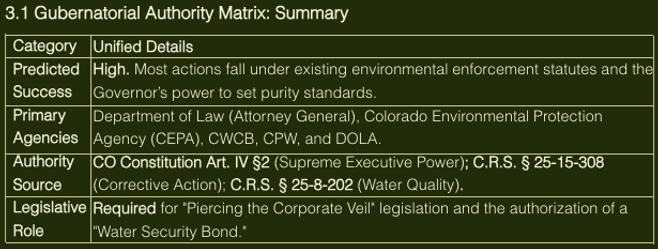
3.2 Enforcement & The "Colorado Cleanup Doctrine"
Objective: Prevent operators from abandoning environmental liabilities and walking away from contamination.
-
Executive Action 3.2.1: Implement the "One Warning + 90 Days" Rule. Direct the newly formed CEPA to adopt "Strict Liability" rules for contamination, giving operators one 90-day window to remediate before state intervention. [Authority: Art. IV §2; C.R.S. § 25-15-308]
-
Executive Action 3.2.2: Prioritize "Environmental Racketeering." Use Supreme Executive Power to direct the Attorney General to prioritize cases against executives who intentionally abandon orphaned wells or PFAS sites. [Authority: Art. IV §2]
-
Legislative Goal: "Pierce the Corporate Veil." Propose legislation enabling the state to place liens on the personal assets of executives who intentionally walk away from remediation duties. [Authority: Statutory Change Required]
3.3 Legacy Contamination & Water Protection
Objective: Ban non-essential toxins and ensure civilizational-timescale management of water purity.
-
Executive Action 3.3.1: Statewide PFAS Purchase Ban. Issue an Executive Order directing all state agencies to cease purchasing any products containing PFAS immediately. [Authority: EO Power/Procurement Authority]
-
Executive Action 3.3.2: Set Zero-Limit Standards. Utilize the Water Quality Control Commission to establish a "Zero-Limit" purity standard for PFAS in all municipal water systems. [Authority: C.R.S. § 25-8-202]
-
Legislative Goal: Water Security Bond. Propose a state bond to fund the immediate remediation of aquifers impacted by historic fracking and industrial runoff. [Authority: Statutory Change/Voter Approval]
3.4 Habitat, Wildlife & Civic Stewardship
Objective: Establish a permanent civilian conservation force and prioritize wildlife connectivity as critical infrastructure.
-
Executive Action 3.4.1: Establish the Colorado Stewardship Corps. Model a state-level Civilian Conservation Corps within AmeriCorps Colorado to handle large-scale habitat restoration and disaster mitigation. [Authority: EO Power; AmeriCorps Partnership]
-
Executive Action 3.4.2: Wildlife Corridor Infrastructure. Direct CPW and the Department of Local Affairs (DOLA) to utilize the Wildlife Crossing Cash Fund to prioritize land acquisitions that connect fragmented habitats. [Authority: C.R.S. Title 33; SB22-151]
-
Executive Action 3.4.3: Strategic Land Acquisition. Utilize Great Outdoors Colorado (GOCO) funds to secure critical conservation easements that protect the state's "Water Sovereignty." [Authority: C.R.S. Title 33]
3.5 Risks, Constraints & Barriers
-
Legal Pushback: Corporate entities will likely challenge "Strict Liability" and "Veil Piercing" in court. Mitigation: Ensure the Attorney General has the dedicated "Racketeering" staff to litigate these cases aggressively.
-
Funding Gaps: Large-scale remediation requires significant capital. Mitigation: Tie the "Water Security Bond" to the revenue generation strategies in Area 15 (e.g., SkyCarbon or State Investment Fund).
-
Administrative Capacity: The creation of CEPA and the Stewardship Corps requires rapid hiring of technical experts. Mitigation: Use the "Education & Human Development" pipelines in Area 11 to fast-track specialized training for these roles.

3.18 Governing Doctrine
A coherent system:
-
Build enough housing
-
Lower healthcare costs
-
Grow high-wage industries
-
Treat cost of living as a system
-
Ensure upward mobility
(Discussion: Accelerated housing construction (Discussion: Municipalities are likely to litigate against state-level zoning overrides, citing Colorado’s robust "Home Rule" constitutional protections. We will redefine housing production as a "Matter of Statewide Concern," a legal threshold that allows state law to supersede local ordinances. Instead of a blunt mandate, the administration will utilize the "Infrastructure-Tied Funding" model. By conditioning discretionary state grants for water, transportation, and broadband on local compliance with housing targets, the state exerts financial "soft power" that bypasses the legal risks of a direct zoning mandate.)
(Discussion: Granting the state authority to place liens on the personal assets of corporate executives requires new statutory authority that is legally complex. The immediate solution is the "Remediation Surety Bond Mandate." Using existing regulatory authority over industrial permits, the administration can require that companies in high-impact sectors (mining, energy) fund a Remediation Surety Bond upfront as a condition of their permit. This ensures the cleanup funds are secured and legally "air-gapped" from the corporation's internal finances, achieving the goal of the "Colorado Cleanup Doctrine" without needing to wait for a change in personal liability laws.)
(Discussion: Establish the Colorado Environmental Protection Agency (CEPA): Consolidating fragmented oversight from multiple agencies into one unified enforcement body. (Discussion: The Governor cannot unilaterally create a new principal department because the Administrative Organization Act of 1968 requires statutory authorization for such a shift. To solve this we will launch the "Executive Science Initiative" on Day One. This uses the Governor’s power to reorganize functions within the executive branch to create a "virtual" CEPA through a Binding Memorandum of Understanding (MOU) between the DNR, ECMC, and CDPHE. This MOU will mandate that these agencies operate under a unified leadership council and shared monitoring data immediately while the formal "Department Reorganization Act" moves through the legislature.
MEMORANDUM OF UNDERSTANDING: CONSOLIDATED ENVIRONMENTAL ENFORCEMENT
1. PURPOSE: This agreement establishes the Colorado Executive Science Initiative (CESI). Under the Governor's "Supreme Executive Power" (Art. IV, §2), this initiative realigns the enforcement functions of the Department of Public Health and Environment (CDPHE), the Department of Natural Resources (DNR), and the Energy and Carbon Management Commission (ECMC). 2. UNIFIED LEADERSHIP: The parties agree to appoint a single Science & Enforcement Lead who shall have administrative oversight of the Air Pollution Control Division, the Water Quality Control Division, and the ECMC enforcement branch. This Lead will report directly to the Governor’s Office to ensure a unified "Zero-Tolerance" posture. 3. DATA INTEGRATION: All environmental monitoring data from the Zero-Tolerance IoT Array shall be housed in a single, unified database managed by OIT. No agency shall maintain "siloed" enforcement data; all violation records must be uploaded to the Public Environmental Dashboard in real-time. 4. THE "CLEANUP" PROTOCOL: All participating agencies hereby adopt the "One Warning + 90 Days" rule. Upon detection of a violation, a unified Notice of Violation will be issued. If remediation is not completed within 90 days, the agencies will act in concert to suspend all operating permits and refer the matter for asset-lien proceedings. 5. STATUTORY COMPLIANCE: This MOU remains in effect as a binding administrative directive until such time as the General Assembly passes a formal Department Reorganization Act to codify these functions into a permanent 20th department.
Colorado’s strengths are real — but affordability pressures threaten them. This plan stabilizes the basics so people can thrive.
OPERATIONS AREA 4:
AFFORDABLE HOUSING
Colorado’s housing crisis is structural: decades of under-building, restrictive zoning, and speculative pressure have created a shortage of 64,000–135,000 homes. Housing costs now outpace wages in most regions. This operations area outlines what a Colorado governor can actually do — and what history teaches about what works.
4.1 Treat “Not Enough Homes” as the Root Problem
Housing crises stem from chronic shortages. If supply doesn’t increase, everything else is triage.
Statewide Housing Production Targets
-
Binding 5–10 year targets by region
-
Based on deficits and projected growth
-
Tie state infrastructure funding (transportation, water, broadband) to local compliance
Override Exclusionary Zoning
Require by-right multifamily and “missing middle” housing in:
-
Job-rich areas
-
Near transit
-
Around universities and hospitals
Localities may vary design — not legality.
4.2 Build and Acquire Permanently Affordable Housing at Scale
The lesson from history is not “never build public housing,” but “don’t repeat segregation and concentrated poverty.”
Colorado Social Housing Initiative
-
Mixed-income, high-quality buildings
-
State or local ownership
-
Permanent affordability baked into ground leases
Acquire Existing Buildings Before They Flip
-
First right of offer/refusal for nonprofits and land trusts
-
State financing for acquisition and rehab
-
Long-term affordability covenants
Use State Land
-
Build on underused state-owned parcels
-
Near campuses, transit, and job centers
-
Permanent affordability requirements
This mirrors Vienna’s successful model: mixed-income, durable, non-market housing.
4.3 Reform Property Taxation and Speculation Incentives
If you’re willing to be unpopular with some owners:
Vacancy Taxes
-
Target long-term empty units in high-demand areas
-
Discourage speculative holding
-
Revenue funds social housing
Higher Property Taxes on
-
Second homes in resort communities
-
Short-term rentals beyond a modest number per owner
Land Value Capture
As zoning liberalizes and infrastructure improves, land values rise. Capture a portion of that publicly created value to reinvest in housing.
4.4 Use Rent Regulation Carefully and Surgically
History is clear: blunt rent control reduces supply. But targeted regulation can protect tenants.
Anti-Rent-Gouging Rules
-
Limit annual increases on existing tenants
-
Allow higher increases for vacant units
Eviction Protections
-
Just-cause eviction
-
Right to counsel
-
Emergency rental assistance
Data-Driven Calibration
Regularly review impacts on:
-
Supply
-
Quality
-
Tenant stability
Adjust accordingly.
4.5 Attack Construction Costs and Timelines
Permitting Deadlines with “Approve by Default”
If agencies don’t act within a set time, code-compliant projects are approved automatically.
Statewide Building Code Modernization
-
Standardize core codes
-
Allow local overlays for real safety needs
-
Promote modular and factory-built housing
One-Stop Approvals
A state unit that coordinates all approvals for projects meeting affordability and climate criteria.
4.6 Direct Support for Low- and Middle-Income Renters
Supply reforms take time. People need help now.
Portable Vouchers and Tax Credits
-
Expand state-level vouchers
-
Renters’ tax credits tied to income and rent burden
Targeted Support
Focus on zip codes with highest displacement risk.
4.7 Lessons from U.S. History
New Deal Public Housing
-
Built real units
-
But segregated, underfunded, and concentrated poverty
Postwar Suburbanization
-
Accessible mortgages for white families
-
Exclusionary zoning and redlining locked others out
Urban Renewal
-
Destroyed communities
-
Reduced affordable housing stock
Shift to Vouchers
-
Helped families
-
But ineffective without increased supply
Core takeaway: You must build more homes and protect tenants.
4.8 Lessons from International Models
Vienna
-
50% of residents in social/cooperative housing
-
High-quality, mixed-income, durable affordability
Singapore
-
80% in government-built HDB flats
-
Strong planning and land acquisition
Europe
-
Permissive zoning
-
Strong tenant protections
-
Social housing integrated into neighborhoods
Lesson: You can be pro-tenant and pro-building at the same time.
4.9 What to Imitate & What to Avoid
Imitate
-
Vienna-style mixed-income social housing
-
Explicit production goals
-
European zoning norms
-
Tenant protections paired with supply expansion
Avoid
-
Segregated public housing
-
Strict rent control without supply
-
Demolition without replacement
-
Overreliance on vouchers
4.10 We Cannot Be Closed To New Housing And Affordable
Every serious solution means:
-
Some neighborhoods get denser
-
Some investors see lower returns
-
Some local control gives way to state goals
In housing we cannot please everyone all the time. We will work to:
-
Open enough land and zoning
-
Build and acquire permanent affordable housing
-
Stop speculation
-
Keep renters housed while supply grows
AUTHORITY AND METHODS
This consolidated Authority and Operational Blueprint for OPERATIONS AREA 4: HOUSING STABILITY & PRODUCTION integrates your foundational principles with the specific gubernatorial powers required to execute them. It ensures that every action—from zoning overrides to social housing—is anchored in the Colorado Constitution and state statutes.
The Master Authority Framework
This area establishes the "Colorado Housing Sovereignty Doctrine." It transitions the state from a passive observer of the market to an active producer and protector of housing, treating the lack of supply as a crisis of state stability that supersedes local exclusionary practices.
4.1 Gubernatorial Authority Matrix: Summary

4.2 Supply & Production: Treating "Not Enough Homes" as the Root
Objective: Rapidly increase housing inventory through standardized codes and state-level targets.
-
Executive Action 4.2.1: Statewide Housing Production Targets. Set firm, data-driven targets for every region and tie state infrastructure funding to local compliance with these goals. [Authority: Art. IV §2; CRS Title 24]
-
Executive Action 4.2.2: Standardize Building Codes & Permitting. Direct the Dept. of Public Safety and OIT to create a digitized, statewide building code to eliminate the "patchwork" of local regulations that slows construction. [Authority: CRS Title 24]
-
Executive Action 4.2.3: One-Stop Housing Approval Office. Establish a centralized state office to provide "approve by default" timelines for state-level permits. [Authority: Art. IV §2]
-
Legislative Goal: Zoning Preemption. Propose legislation for mandatory by-right multifamily zoning and the override of exclusionary local zoning in high-demand corridors. [Authority: Statutory Change Required]
4.3 Social Housing & State Land Utilization
Objective: Use state resources to build and acquire permanently affordable, mixed-income housing at scale.
-
Executive Action 4.3.1: Prioritize Housing on State Parcels. Direct the State Land Board to prioritize residential development on state-owned land, moving away from purely extractive leasing. [Authority: CRS Title 36]
-
Executive Action 4.3.2: Social Housing Initiative. Launch a state-led development model—inspired by the "Vienna Model"—focused on high-quality, mixed-income housing that remains state-owned or under permanent affordability covenants. [Authority: Art. IV §2; Budget Authority]
-
Executive Action 4.3.3: Speculation Acquisition Fund. Establish a fund to acquire buildings at risk of speculative "flipping" to preserve them as stable, affordable units. [Authority: Art. IV §2]
4.4 Renter Protection & Market Reform
Objective: Curb price-gouging and speculation while providing direct support to vulnerable residents.
-
Executive Action 4.4.1: Emergency Anti-Gouging Orders. Utilize executive authority to issue temporary caps on rent increases during declared economic or housing emergencies. [Authority: Art. IV §2]
-
Executive Action 4.4.2: Expand Eviction Prevention. Direct DOLA to scale up legal and financial support programs to prevent displacement in high-risk zip codes. [Authority: Art. IV §2]
-
Legislative Goal: Property Tax & Vacancy Reform. Propose a vacancy tax on long-term empty units and a restructuring of property taxes to favor residents over speculators and short-term rental (STR) moguls. [Authority: CO Constitution Art. X; Statutory Change Required]
-
Legislative Goal: Just-Cause Eviction. Codify statewide protections to ensure tenants cannot be displaced without a valid, documented cause. [Authority: Statutory Change Required]
4.5 Risks, Constraints & Barriers
-
Local Control Resistance: Municipalities may sue to protect "home rule" zoning authority. Mitigation: Focus state overrides on "matters of statewide concern" (e.g., economic stability and transit-oriented development).
-
TABOR & Funding: Large-scale social housing requires significant capital. Mitigation: Use the "Colorado Infrastructure Bank" (Area 15) to issue revenue bonds that are exempt from TABOR limits.
-
Construction Capacity: Material costs and labor shortages could stall targets. Mitigation: Integrate the "Teacher-Style" pay premiums and "Civic Corps" training (Area 11 & 13) to build a robust state-supported construction workforce.
-
Building the Zero-Tolerance Monitoring System (the statewide IoT sensor array for air and water) involves high technical complexity and significant data infrastructure costs that could exceed the General Fund's immediate capacity. The solution is a "Modular Infrastructure" roll-out through the SkyCarbon Enterprise. Rather than a single statewide launch, the state will implement the sensor array in "Priority Stewardship Zones"—starting with high-impact industrial corridors like Pueblo and the Front Range. By funding this through the Enterprise fee structure (which is TABOR-exempt), the state can build the network incrementally, using the revenue from carbon-sequestration leases to pay for the expansion of the data grid.
OPERATIONS AREA 5:
HOMELESSNESS & BEHAVIORAL HEALTH
Housing costs and homelessness are top concerns for Coloradans. The state must treat homelessness as a housing and health issue — not a policing issue — while maintaining public order and dignity.
5.1 Core Stance
-
Housing is a prerequisite for recovery
-
Serious mental illness and addiction are health issues
-
Public order matters
-
The state must prevent deaths on the street
This is the spine of the approach.
5.2 Housing First + Services
Evidence shows Housing First keeps 70–90% of chronically homeless people housed long-term.
Principles
-
Permanent housing
-
No sobriety requirement
-
Voluntary, intensive services
5.3 Permanent Supportive Housing (PSH)
Target Population
-
Long-term or repeated homelessness
-
Serious mental illness
-
High ER/jail use
Build/Convert Enough Units
-
New construction
-
Hotel/motel conversions
-
Master-leasing private units
Affordability & Tenure
-
Leases in tenant’s name
-
Normal tenant rights
5.4 Assertive Community Treatment (ACT)
PSH works when paired with ACT teams:
-
Social workers
-
Nurses
-
Psychiatrists
-
Substance use counselors
-
Vocational specialists
Available 7 days a week, often 24/7.
Focus on:
-
Medication support
-
Daily living skills
-
De-escalation
-
Tenancy support
5.5 Coordinated Entry & Crisis Response
Coordinated Access
-
One statewide or regional assessment
-
Prioritize highest-need individuals
Crisis Outreach Teams
Mental health professionals + peers + EMS for:
-
Welfare checks
-
Mental-health-driven disturbances
Encampment Protocol
No sweeps without:
-
Shelter/housing offers
-
On-site outreach
-
Storage for belongings
5.6 Prevention: Stopping the Flow In
No Discharge to Homelessness
From:
-
Hospitals
-
Jails
-
Foster care
Bridge Housing
For:
-
People leaving institutions
-
People in crisis
Includes case management and reconnection support.
5.7 Mental Illness & Addiction as Health Issues
Expand Behavioral Health Capacity
-
Community mental health centers
-
Substance use treatment
-
Integrated care
-
Telehealth
-
Outreach-based engagement
Embed Services in Housing
-
Counseling
-
Psychiatric visits
-
Peer support
Civil Commitment (Careful Use)
For people who are:
-
Acutely dangerous
-
Unable to care for themselves
With strong oversight.
5.8 Public Order + Compassion
Behavioral Standards
Enforce laws around:
-
Violence
-
Harassment
-
Dangerous behavior
-
Obstruction
Paired with:
-
Shelter offers
-
Diversion to treatment
Problem-Solving Courts
-
Mental health courts
-
Drug courts
-
Homelessness courts
5.9 Funding & Structure
Combine Streams
-
Medicaid
-
State behavioral health funds
-
Federal homelessness grants
-
County/city contributions
-
Colorado Supportive Housing & Recovery Fund
Results-Based Contracts
Fund providers based on:
-
Housing retention
-
Reduced ER/jail use
-
Tenant safety
5.10 Narrative for Coloradans
“Colorado will stop pretending that jails, ERs, and sidewalks are mental health policy. We will build housing with the right support so people can come inside and stay inside. We will enforce basic standards in public spaces — and treat serious mental illness and addiction as health issues, not moral failures.”
AUTHORITY AND METHODS
Colorado’s homelessness and behavioral-health crisis is fundamentally a housing + health problem, not a policing problem. The governor has broad authority over health systems, behavioral health, emergency response, Medicaid administration, and state housing programs — which means this OPERATIONS Area is one of the strongest in terms of executive power. This consolidated Authority and Operational Blueprint for OPERATIONS AREA 5: HOMELESSNESS & BEHAVIORAL HEALTH integrates your foundational principles with the specific gubernatorial powers required to execute them. It ensures every action—from Housing First to crisis response—is anchored in the Colorado Constitution and state statutes. This area establishes the "Health-First Housing Doctrine." It moves from a criminal-justice-led approach to a clinical and housing-led model. By utilizing the state’s supreme executive power over health systems and Medicaid, the Governor treats homelessness as a treatable public health crisis rather than a policing matter.
5.1 Gubernatorial Authority Matrix: Summary

5.2 Housing First & Permanent Supportive Housing (PSH)
Objective: End chronic homelessness by providing stable housing as a prerequisite for health treatment.
-
Executive Action 5.2.1: Expand Housing First Statewide. Direct DOLA and DHS to prioritize "Housing First" models in all state-funded homelessness grants, ensuring that sobriety or treatment are not barriers to entry. [Authority: C.R.S. Title 24 & 26]
-
Executive Action 5.2.2: Medicaid-Funded Tenancy Support. Direct the Department of Health Care Policy and Financing (HCPF) to utilize Medicaid waivers to cover "wraparound" services like case management and mental health support within PSH units. [Authority: Medicaid Waiver Authority]
-
Executive Action 5.2.3: Rapid Hotel/Motel Conversions. Utilize the Division of Housing’s authority to fast-track the acquisition and conversion of underutilized properties into non-congregate shelters or permanent housing. [Authority: C.R.S. § 24-32-721]
5.3 Assertive Community Treatment (ACT) & Crisis Response
Objective: Deploy mobile, high-intensity clinical teams to provide care directly in the community.
-
Executive Action 5.3.1: Statewide ACT Expansion. Direct the BHA to expand Assertive Community Treatment teams—multidisciplinary groups including doctors, nurses, and social workers—to provide 24/7 care in high-need corridors. [Authority: C.R.S. Title 27]
-
Executive Action 5.3.2: Statewide Coordinated Entry. Direct OIT and DOLA to build a unified "Real-Time Bed Tracker" and coordinated entry system to ensure no one is "discharged to homelessness" from jails or hospitals. [Authority: C.R.S. § 24-37.5]
-
Executive Action 5.3.3: Humane Encampment Protocols. Issue an Executive Order establishing statewide standards for public order that require a credible offer of shelter and services before any encampment clearing occurs. [Authority: Art. IV §2]
-
Discussion: The ACT Team "Universal Service" Surge (Workforce) The shortage of qualified healthcare and social work professionals is a massive roadblock to the expansion of Assertive Community Treatment (ACT) teams. The solution is the "Colorado Health Security Corps." Using executive authority over the Department of Higher Education, the state will implement an Emergency Licensing Reciprocity order and a Service-for-Debt-Swap program. This offers immediate state tax forgiveness and tuition reimbursement to any qualified clinician who relocates to Colorado for a three-year service commitment. This utilizes existing workforce funds to "buy" the labor market capacity needed to execute the platform's medical mandates.
5.4 Prevention & System Integration
Objective: "Close the front door" to homelessness by stabilizing individuals before they lose housing.
-
Executive Action 5.4.1: The "No-Wrong-Door" Policy. Mandate that all executive agencies (DHS, BHA, HCPF) share data to identify individuals at high risk of displacement and provide "Bridge Housing" during transitions from state care. [Authority: Admin Direction]
-
Executive Action 5.4.2: Integrated Behavioral Health Safety Net. Direct the BHA to approve and regulate "Comprehensive Safety Net Providers" that offer both mental health and substance use treatment under one roof. [Authority: C.R.S. § 27-50-101]
-
Executive Action 5.4.3: Supportive Housing & Recovery Fund. Consolidate fragmented funding streams from multiple agencies into a single, results-based fund for community-led recovery and housing initiatives. [Authority: Budgetary Authority]
5.5 Risks, Constraints & Barriers
-
Workforce Shortages: Lack of qualified clinicians and social workers can stall ACT and PSH expansion. Mitigation: Use Area 11 (Education) and Area 13 (Civic Corps) to create "Behavioral Health Apprenticeships" with state-funded tuition.
-
Local Coordination: Some cities may resist the "Health-First" doctrine in favor of "Clearance-Only" policies. Mitigation: Tie state DOLA housing grants and OEDIT economic incentives to local compliance with state "Order + Compassion" standards.
-
Legal & Civil Rights: Encampment protocols must balance public safety with 9th Circuit and state legal precedents (e.g., Martin v. Boise). Mitigation: Document all "credible offers of shelter" via the statewide coordinated entry system to ensure legal defensibility.
OPERATIONS AREA 6:
HIGH-QUALITY, AFFORDABLE HEALTHCARE
FOR EVERYONE
Healthcare costs — insurance, prescriptions, access — are among the top concerns for Coloradans. This OPERATIONS Area outlines a cradle-to-grave healthcare security plan grounded in science, stability, and dignity.
6.1 Core Principles
-
Universality: Everyone has access to essential care
-
Stability: Coverage doesn’t vanish due to paperwork or job changes
-
Affordability: Predictable out-of-pocket costs
-
Science-Based: Policy follows evidence
-
Dignity in Aging: Seniors can age safely at home or in supportive communities
This is the Colorado Health Security Covenant.
6.2 Layered Universal Coverage Architecture
Modeled on California’s success:
-
Strong Medicaid backbone
-
Strong state marketplace
-
State-funded expansions to fill gaps
6.3 Medicaid as Backbone
Maximize Enrollment
-
Automate renewals
-
Reduce paperwork purges
-
Use continuous eligibility options
State-Funded Gap Filling
-
Cover low-income adults above federal thresholds
-
Protect people from losing coverage due to minor income changes
6.4 Strengthening the Colorado Option
Make It the Default
For people without employer coverage.
Enforce Premium Reduction Targets
-
Rate denial or penalties for noncompliance
Coordinate with Employers
Encourage small employers to steer workers into the Colorado Option.
6.5 Public Backstop for the Uninsured
Colorado Health Security Plan
Payer of last resort for:
-
Gig workers
-
People between jobs
-
People ineligible for federal subsidies
Funded by:
-
Sliding-scale premiums
-
State subsidies
-
Reinsurance
6.6 Continuous Coverage from Birth to Old Age
Automatic Enrollment at Birth
Every child is enrolled in Medicaid/CHIP or Colorado Option.
Continuous Eligibility
Multi-year coverage intervals for children.
No-Gap Rule
When someone loses employer insurance, they are automatically offered coverage.
Support for Seniors
State assistance for Medigap, Medicare Advantage, and drug coverage.
6.7 Cost Control Through Science
Prescription Drug Affordability Board
-
Set upper payment limits
-
Use outcomes and cost-effectiveness data
Hospital Cost Oversight
-
Require detailed cost reporting
-
Public hearings for major price increases
-
Reject unjustified rate hikes
Science-Based Benefit Design
-
Reduce copays for high-value care
-
De-emphasize low-value care
6.8 Senior Care: Home, Community & Dignity
Expand Home and Community-Based Services
-
In-home aides
-
Homemaker services
-
Adult day programs
-
Respite care
Supportive Senior Housing
-
Health-integrated senior housing
-
Medicaid waivers for assisted living
Senior Navigation Centers
Help families understand:
-
Medicare
-
Medicaid
-
Long-term care options
6.9 Shielding Colorado from Federal Volatility
Strategic Waivers
Use 1115 and 1332 waivers to:
-
Lock in flexibility
-
Protect coverage
Health Security Reserve
A dedicated fund to cushion against federal cuts.
State Reinsurance
Keep premiums stable regardless of federal behavior.
Guardrail Laws
Protect:
-
Essential health benefits
-
Reproductive rights
-
Mental health parity
-
Preexisting condition protections
6.10 Navigation, Simplicity & Trust
Colorado Health Navigator Corps
Navigators embedded in:
-
Clinics
-
Libraries
-
Community centers
Help with:
-
Enrollment
-
Renewals
-
Paperwork
-
Coverage selection
Radical Simplicity
One statewide portal:
-
“Am I covered”
-
“What are my options”
-
“Who can help me today”
AUTHORITY AND METHODS
Colorado’s healthcare system is strained by rising costs, hospital consolidation, insurance complexity, and uneven access across rural and urban regions. The governor has broad authority over Medicaid, insurance regulation, hospital accountability, public health, and state-funded healthcare programs — making this one of the strongest areas for executive action. It ensures that every action—from the "Price Shield" to the "Birth-to-Three" pilot—is anchored in the Colorado Constitution and state statutes. This area establishes the "Colorado Health Security Covenant." It transitions the state from a passive participant in federal healthcare markets to an active guarantor of coverage. By utilizing the state’s supreme executive power over insurance regulation and Medicaid administration, the Governor shields Coloradans from federal volatility and ensures that healthcare is treated as a foundational pillar of economic stability.
6.1 Gubernatorial Authority Matrix: Summary

6.2 Universal Architecture & Continuous Coverage
Objective: Eliminate gaps in care caused by administrative "churn" and federal policy shifts.
-
Executive Action 6.2.1: The "Continuous Coverage" Mandate. Utilize state-only "Affordability Enterprise" funds to maintain 12-month continuous eligibility for all children under 19, bypassing federal redetermination hurdles. [Authority: C.R.S. Title 25.5]
-
Executive Action 6.2.2: Automated Bridge Enrollment. Direct HCPF and DOI to integrate the PEAK Portal with the state marketplace. If an individual loses Medicaid eligibility, they are automatically bridged into a $0-premium Colorado Option plan for 60 days. [Authority: Admin Direction/CRS 24-37.5]
-
Executive Action 6.2.3: Birth-to-Three State Pilot. Launch a guaranteed, uninterrupted Medicaid coverage program for infants in households under 200% FPL through their third birthday. [Authority: Art. IV §2; State Pilot Authority]
6.3 Cost Control, Transparency & The "Price Shield"
Objective: Use regulatory teeth to blunt the impact of inflation and high-cost biologics.
-
Executive Action 6.3.1: Enforce Upper Payment Limits (UPL). Direct the Prescription Drug Affordability Board (PDAB) to finalize and enforce payment limits on high-cost biologics (e.g., Ozempic, Enbrel), ensuring savings are passed to consumers. [Authority: C.R.S. Title 10]
-
Executive Action 6.3.2: Activate the 2026 "Price Shield." Implement the HB25B-1006 emergency state-funded "wrap" to lower premiums for households between 100%–400% FPL following the sunset of federal tax credits. [Authority: HB25B-1006; Budget Authority]
-
Executive Action 6.3.3: Hospital Cost Reporting Transparency. Require all hospitals participating in the Colorado Option to provide transparent cost reporting to the DOI to justify rate filings. [Authority: C.R.S. Title 10]
6.4 Dignity in Aging & Senior Care
Objective: Eliminate waitlists for home-based care and strengthen nursing home oversight.
-
Executive Action 6.4.1: Community First Choice (CFC) Activation. Transition seniors from "Waiver Waitlists" into the mandatory CFC state plan, providing guaranteed in-home aides and meals. [Authority: 1915(k) Medicaid Authority]
-
Executive Action 6.4.2: Expand HCBS Oversight. Direct CDPHE to increase the frequency of nursing home inspections and increase provider reimbursement rates to ensure a stable caregiver workforce. [Authority: C.R.S. Title 25 & 25.5]
6.5 Risks, Constraints & Barriers
-
Federal Waiver Timelines: CMS approval for Medicaid changes can be slow. Mitigation: Utilize state-only "Affordability Enterprise" funds to bridge the gap while federal approvals are pending.
-
Insurer & Hospital Lobbying: Major stakeholders may resist rate regulations and UPLs. Mitigation: Use the "Radical Transparency" doctrine from Area 1 to publish data on hospital margins and insurer profits alongside premium increase requests.
-
Workforce Shortages: Lack of home-care aides and primary care providers can limit the efficacy of coverage. Mitigation: Use the "Civic Corps" and "Hiring Pipelines" from Areas 11 and 13 to create state-funded training-to-employment tracks for healthcare workers.
OPERATIONS AREA 7:
IMMIGRATION, PUBLIC SAFETY & POLARIZATION
Colorado voters — especially independents — consistently rank immigration, crime, and public safety among their top concerns. These issues are often entangled with national polarization, misinformation, and fear. A governor must approach them with clarity, fairness, and a commitment to both safety and dignity. This OPERATIONS Area: addressing polarization at its cultural roots, shifting the frame from grievance to contribution, building a statewide identity that transcends party, reinforcing your “citizen-directed government” philosophy, giving voters a positive, actionable vision of civic renewal.

7.1 Voter Concerns
Polling shows:
-
High concern about border security
-
High concern about crime and public safety
-
High frustration with partisan conflict
-
Desire for rational, humane, predictable policy
Coloradans want safety without cruelty, order without chaos, and a system that respects both law and humanity.
7.2 Rational, Humane Immigration Framework
Colorado cannot control federal immigration law — but it can control how people are treated within the state.
Citizens’ Pledge
A voluntary pledge for new residents that affirms:
-
Commitment to community
-
Respect for Colorado’s laws
-
Participation in civic life
-
English as the shared civic language (with interpretation and education support). If you want to live and do business in Colorado you must be able to communicate and employers must provide linguistic education not just signage.
Education & Interpretation
-
Access to English classes
-
Interpretation services for essential services
-
Support for integration into schools, workplaces, and communities
This is not punitive — it is an invitation into shared civic life.
7.3 Voting Safety as Public Safety
Election security is not a partisan issue — it is a public safety issue.
Colorado will:
-
Maintain secure, transparent, auditable elections
-
Protect election workers
-
Provide clear, consistent information
-
Treat threats to election infrastructure as threats to public safety
Predictability reduces fear. Fear reduction reduces polarization.
7.4 Public Safety Without Partisanship
Colorado will:
-
Enforce laws consistently
-
Support local law enforcement with training and resources
-
Expand co-responder models for mental-health-driven incidents
-
Use data to target high-risk areas
-
Strengthen community-based violence prevention
Public safety is not a culture war. It is a basic function of government.
7.5 Reducing Polarization Through Predictability
Polarization thrives in uncertainty.
Colorado will:
-
Publish statewide risk maps
-
Provide transparent data on crime, immigration, and public safety
-
Maintain calm, factual communication
-
Avoid inflammatory rhetoric
-
Model respectful disagreement
A predictable government is a stabilizing force.
7.6 Rebuilding Civic Responsibility & Shared Identity
Modern American life has trained people to think like consumers rather than citizens. Corporations and institutions have optimized convenience, passivity, and individual entitlement — and the result is a public that feels disconnected from one another and from the work of democracy. Colorado can lead the nation in reversing this trend by rebuilding a culture of contribution, shared responsibility, and civic pride.
This is not about guilt or nostalgia. It is about designing systems that make civic participation normal, meaningful, and expected — and that reconnect Coloradans to one another through shared work, not shared outrage.
7.7 Colorado Civic Participation Framework
Colorado will establish a statewide framework that strengthens civic identity through action, not rhetoric.
7.8 Civic Rituals That Build Belonging
People develop civic responsibility when they participate in shared rituals that make them feel part of something larger.
Colorado will create:
-
Colorado Civic Day — an annual statewide day of service focused on wildfire mitigation, water conservation, trail work, and community support.
-
County-level civic ceremonies welcoming new residents and honoring local problem-solvers.
-
Citizen Juries (already in this plan) as a visible ritual of shared responsibility, not just a policy tool.
Ritual builds belonging. Belonging builds responsibility.
7.9 Shared Work as the Antidote to Polarization
Polarization thrives when politics is about opinions. Unity emerges when politics is about tasks.
Colorado will expand:
-
Colorado Civic Corps into a year-round, visible institution.
-
Micro-missions — 2-hour service tasks residents can sign up for weekly.
-
Neighborhood-level projects that bring people together across political lines.
When people work together, they stop seeing each other as enemies.
7.10 Identity Shift: From Consumer to Contributor
Colorado will replace “customer service” language with citizen partnership language across state agencies.
Programs will be framed as:
-
shared investments
-
shared responsibilities
-
shared benefits
Messaging will emphasize: “Colorado works when Coloradans work for Colorado.”
Identity shapes behavior. If people see themselves as contributors, they behave like contributors.
7.11 Make Participation the Default
People participate when participation is easy, expected, and normalized.
Colorado will:
-
Send automatic invitations to local service events
-
Integrate civic prompts into state apps and portals
-
Create “one hour a month” civic commitments
-
Use opt-out rather than opt-in volunteer systems
-
Partner with schools and employers to normalize civic hours
Default settings shape behavior more than moral appeals.
7.12 Visible Leadership & Embodied Example
Citizens follow what leaders model.
Colorado will:
-
Have the Governor and Cabinet participate in monthly service projects
-
Highlight ordinary Coloradans who give time, not just money
-
Create a Colorado Heroes program recognizing civic contribution
Leadership by example builds a culture of shared sacrifice.
7.13 A Narrative of Shared Fate
Colorado will communicate a simple truth:
-
Your air is my air
-
Your water is my water
-
Your safety is my safety
-
Your future is my future
This narrative reinforces the idea that Coloradans rise or fall together — and that civic responsibility is not charity, but mutual protection.
7.14 Civic Duty as a Source of Pride
Colorado will reintroduce civic duty as a modern virtue.
Initiatives include:
-
Civic duty curriculum in schools
-
Civic apprenticeships for young adults
-
A voluntary Colorado Civic Oath for new residents
-
Public campaigns celebrating service and responsibility
Duty is not old-fashioned. It is the backbone of a functioning society.
7.15 Incentives That Reward Contribution
Colorado will create structures that reward civic participation without commodifying it.
Examples:
-
Civic participation credits for state park passes
-
Recognition boards in public buildings
-
Community dashboards that highlight local service hours
These incentives normalize contribution and make civic engagement visible.
7.16 Cross-Group Contact Through Shared Purpose
Colorado will design service programs that intentionally mix:
-
rural and urban residents
-
immigrants and native-born Coloradans
-
younger and older residents
-
people across political identities
Shared work dissolves stereotypes and builds trust.
AUTHORITY AND METHODS
This consolidated Authority and Operational Blueprint for OPERATIONS AREA 7: PUBLIC SAFETY, IMMIGRATION & ELECTION INTEGRITY integrates your foundational principles with the specific gubernatorial powers required to execute them. It ensures that every action—from secure voting to humane immigrant coordination—is anchored in the Colorado Constitution and state statutes.
OPERATIONS AREA 7: PUBLIC SAFETY, IMMIGRATION & ELECTION INTEGRITY
The Master Authority Framework
This area establishes the "Colorado Safety & Stability Doctrine." It transitions the state from a reactive posture to a proactive, predictable framework for public order. By utilizing the state’s supreme executive power over the Department of Public Safety (DPS) and interagency coordination, the Governor ensures that safety is treated as a non-partisan foundation for civic trust.
7.1 Gubernatorial Authority Matrix: Summary
7.2 Humane Immigration & Community Safety
Objective: Maintain public order and dignity through clear boundaries between state services and federal enforcement.
-
Executive Action 7.2.1: The Office of New Americans (ONA) Expansion. Direct the ONA to serve as the central hub for immigrant integration, ensuring access to emergency services, legal defense funds, and language navigation. [Authority: C.R.S. Title 24; Executive Authority]
-
Executive Action 7.2.2: Entanglement Protections. Reaffirm through Executive Order that state and local resources—including DPS and Judicial Department data—are not to be used for unreimbursed federal civil immigration enforcement, in compliance with SB25-276. [Authority: SB25-276; Art. IV §2]
-
Executive Action 7.2.3: Victim & Witness Safety. Direct the DPS to enforce protocols that protect the rights of all victims and witnesses to report crimes without fear of status-based retaliation. [Authority: C.R.S. Title 24]
7.3 Voting Safety & Election Integrity
Objective: Protect the "Gold Standard" of Colorado elections through cybersecurity and physical infrastructure security.1
-
Executive Action 7.3.1: National Guard Cybersecurity Activation.2 Continue the precedent of activating the Colorado National Guard’s cyber units to assist the Secretary of State in defending election infrastructure against foreign and domestic threats.3 [Authority: Art. IV §5; EO Power]
-
Executive Action 7.3.2: Misinformation Transparency Dashboard. Direct OIT and the DPS to launch a public portal to track and debunk coordinated disinformation campaigns targeting election security or public safety. [Authority: C.R.S. § 24-37.5]
-
Executive Action 7.3.3: County Clerk Infrastructure Support. Use budgetary authority to fund secure wireless routers (Cradlepoints) and 24/7 video surveillance for ballot drop boxes in all 64 counties. [Authority: C.R.S. Title 1; Budget Authority]
7.4 Non-Partisan Public Safety & Polarization Reduction
Objective: Restore predictability through data-driven risk mapping and evidence-based policing.
-
Executive Action 7.4.1: Statewide Risk Mapping. Direct the Colorado Water Conservation Board (CWCB) and DPS to publish unified maps of climate, infrastructure, and public safety risks to help communities prepare for hazards. [Authority: C.R.S. § 24-32-101; SB15-245]
-
Executive Action 7.4.2: Behavioral Health Co-Response. Expand the "Behavioral Health Crisis Response" teams (CIRT) statewide to ensure that mental health professionals respond alongside law enforcement for behavioral health calls. [Authority: C.R.S. Title 27]
-
Executive Action 7.4.3: Weekly Safety Briefings. The Governor will hold weekly, non-ideological briefings on state safety metrics to provide a calm, predictable counter-narrative to national polarization. [Authority: Art. IV §8]
7.5 Risks, Constraints & Barriers
-
Local Law Enforcement Autonomy: Sheriffs and local police maintain significant operational independence. Mitigation: Use state POST (Peace Officer Standards and Training) certification and state grant funding to incentivize compliance with "Shared Fate" standards.
-
Political Polarization: National rhetoric regarding immigration can disrupt state-level coordination. Mitigation: Focus exclusively on "Community Safety" and "Economic Contribution," highlighting the cost-savings of effective integration vs. the high cost of uncompensated care and detention.
-
Ballot Measure Conflict: Initiative 95 (2026) may challenge current entanglement laws. Mitigation: Prepare a "Rule of Law" contingency plan that balances any voter-mandated law enforcement cooperation with existing constitutional privacy protections.
-
Discussion: GO: The "POST Certification" Law Enforcement Lever Resistance from local police departments regarding state-led "sovereignty" or "safety" mandates (such as the Zero-Tolerance Monitoring) can stall implementation. The solution is the "POST Compliance Multiplier." By tying Peace Officer Standards and Training (POST) certification and state public safety grant eligibility to the adoption of the "Good Neighbor" Service Model, the state creates a powerful financial and professional incentive for local agencies to align with executive directives. This avoids a direct confrontation over local police autonomy while ensuring uniform statewide standards for public safety.
CLIMATE CHANGE
& COLORADO’S FUTURE
Climate change is reshaping Colorado’s water, forests, wildlife, agriculture, and economy as we are watching. Only the most imperceptive among us can fail to notice 60 degree temperatures on Christmas Day and new grass growing in January. While “kitchen-table issues” often outrank climate in polls, environmental stability remains a major concern — and a foundational context for every other issue. Colorado can lead the Mountain West in climate resilience, carbon removal, and water security. Operations, Authority and Methods in this area will be tied to the Interstate SkyCarbon Blueprint.

8.1 Climate Risk & Public Concern
Coloradans consistently express concern about:
-
Wildfire smoke
-
Drought
-
Water scarcity
-
Wildlife loss
-
Extreme weather
-
Air quality
Climate is not a niche issue — it is the context for all governance.
8.2 Colorado as a DACR Hub (SkyCarbon Blueprint)
Colorado can become the geographic center of a regional network of Direct Atmospheric Carbon Removal (DACR) facilities.
Why Colorado?
-
Engineering talent
-
Research universities
-
Existing energy infrastructure
-
High elevation (lower air density improves efficiency)
-
Central location for interstate coordination
Benefits
-
High-wage jobs
-
Industrial diversification
-
Federal funding inflows
-
New manufacturing sectors
-
Rural economic development
DACR is not a cost — it is 21st-century infrastructure.
8.3 Water Security & Colorado River Leadership
The Colorado River is entering a period of historic stress.
Colorado will:
-
Lead basin negotiations
-
Protect agricultural viability
-
Modernize water infrastructure
-
Expand water recycling
-
Restore wetlands and riparian zones
-
Use science-based allocation models
Water is Colorado’s backbone. Protecting it is non-negotiable.
8.4 Integrating Climate into All State Decisions
Every major decision — housing, transportation, energy, land use — will include:
-
Climate impact assessment
-
Water impact assessment
-
Air quality assessment
-
Soil and habitat assessment
Climate becomes a governing lens, not a standalone issue.
8.1 Climate Risk
Understanding and Communicating the Threat
Governor’s Direct Powers
- Publish statewide climate risk assessments
-
Direct agencies to integrate climate science into planning
-
Create public dashboards for wildfire, drought, and air quality
-
Coordinate climate communication across agencies | | Requires Legislature? | No. | | Risks / Constraints | Data complexity, political pushback from climate-skeptical actors. |
AUTHORITY AND METHODS
This consolidated authority and operational blueprint for operations area 8: climate, water & the SkyCarbon frontier integrates your foundational principles with the specific gubernatorial powers required to execute them. It ensures that every action—from carbon sequestration to Colorado river defense—is anchored in the Colorado constitution and the 2025 carbon management roadmap. This area establishes the "Colorado frontier doctrine." it transitions the state from climate-reactive to climate-industrial, turning carbon management into a cornerstone of the state's economy. By utilizing supreme executive power over state lands and environmental regulation, the governor positions Colorado as the global hub for atmospheric healing and water security.
8.1 Gubernatorial Authority Matrix: Summary


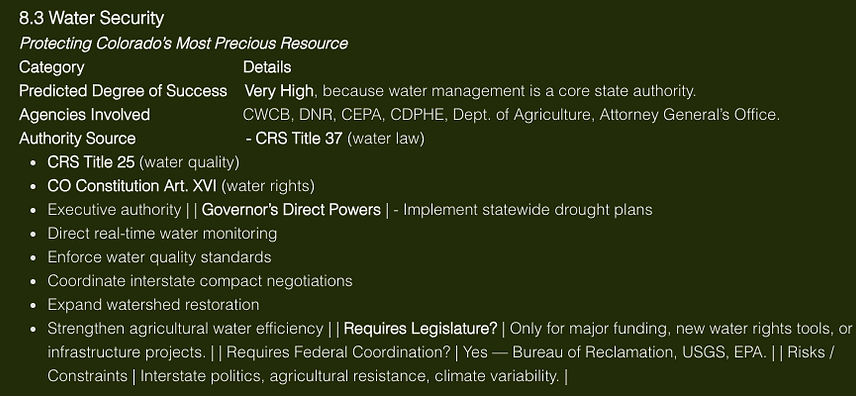


8.2 SkyCarbon: The New Mountain-Industrial Economy
Objective: Capture and sequester gigatons of $CO_2$ while creating a high-wage "Carbon Removal Workforce."
-
Executive Action 8.2.1: Establish DACR Innovation Hubs. Direct the CEO and OEDIT to designate the Pueblo-Cañon City corridor as the state’s first Direct Air Capture & Resilience (DACR) zone, utilizing existing industrial rail and the Denver Basin’s geologic storage. [Authority: HB23-1210; Art. IV §2]
-
Executive Action 8.2.2: State Land Carbon Leases. Direct the State Land Board to prioritize 50,000 acres for co-locating wind/solar farms with DACR facilities, ensuring the capture process is powered by 100% renewable energy. [Authority: CRS Title 36; SLB Policy]
-
Executive Action 8.2.3: Carbon-Sequestered Infrastructure. Mandate that CDOT prioritize "carbon-negative" concrete—utilizing captured atmospheric carbon—for all state highway projects by 2027. [Authority: EO D 2026-015; SB24-214]
8.3 The Water "Firewall": Protecting Every Drop
Objective: Secure Colorado’s water future through aggressive demand management and riparian restoration.
-
Executive Action 8.3.1: The Hydrologic Trigger Mandate. Lead the "Upper Basin Bloc" in establishing a hard line with the Bureau of Reclamation: Lower Basin deliveries must be automatically reduced if Lake Powell drops below critical safety tiers. [Authority: C.R.S. § 37-60-106]. Of course, lower Basin states (CA, AZ) will almost certainly sue if Colorado unilaterally reduces water deliveries based on Lake Powell levels. The solution is to move from "unilateral action" to "Compact Defense Litigation." Instead of a simple mandate, the Governor directs the Attorney General and the CWCB to file a proactive "Quiet Title" action in federal court to affirm the 1922 Compact’s inherent protections for Upper Basin development. By framing the Hydrologic Trigger as a defensive measure required by the "Law of the River," the state shifts the legal burden to the Lower Basin to prove why Colorado should be forced into "catastrophic depletion".
-
Executive Action 8.3.2: "Sponge Landscape" Initiative. Direct the CWCB to launch a massive riparian restoration project, restoring 500 miles of wetlands to serve as natural water storage and wildfire buffers. [Authority: Colorado Water Plan; Budget Authority]
-
Executive Action 8.3.3: Scaling Alternative Transfer Methods (ATMs). Expand state-backed leasing programs that allow farmers to lease water to cities during droughts without permanently drying up Colorado’s agricultural lands. [Authority: C.R.S. Title 37]
8.4 Risks, Constraints & Barriers
-
Interstate Litigation: Lower Basin states (CA, AZ) may sue over "Hydrologic Triggers." Mitigation: Rely on the "Law of the River" and the 1922 Compact’s inherent protections for Upper Basin development.
-
DACR Energy Demand: Carbon capture is energy-intensive. Mitigation: Use the "State Land Board Partnership" to ensure all DACR projects are paired with new, dedicated renewable generation.
-
Pore Space Ownership: Conflicts may arise over who owns the underground "storage space" for carbon. Mitigation: Utilize the 2025 regulatory framework to clarify state-owned pore space and long-term liability.
OPERATIONS AREA 9:
PRINCIPLES-BASED GOVERNANCE
Colorado’s founding values — equal dignity, fairness, stewardship — can be operationalized into modern governance. This Operational Area outlines how to embed “self-evident truths” into law, process, and daily decision-making.
9.1 Codifying Principles in Law
Colorado Principles of Governance Act
A statute that:
-
Names core principles
-
Requires agencies to apply them
-
Creates a legal hook for accountability
Environmental Rights
Embed the right to:
-
Breathable air
-
Drinkable water
-
Safe soils
…into environmental and public health statutes.
9.2 Decision-Making Machinery
Every major decision must pass a three-part test:
-
Citizen Input
-
Science & Evidence
-
Principles
Agencies publish a Principled Decision Memo explaining how each factor shaped the outcome.
9.3 Required Impact Assessments
For major actions:
-
Health Impact Assessment
-
Environmental Impact Assessment
-
Equity & Environmental Justice Assessment
Agencies cannot act in willful disregard of these assessments.
9.4 Citizen Input as a Structural Requirement
-
Real-time dashboard
-
Formal comment
-
Citizen panels
-
“You Said / We Did” reports
Citizen input becomes part of the workflow, not a checkbox.
9.5 Principles Office / Ombudsperson
A new office that:
-
Reviews major decisions
-
Flags violations of principles
-
Accepts citizen petitions
-
Issues public opinions
This builds long-term precedent.
9.6 Applying Principles to Hard Cases
Example: fracking near a community
-
Citizen input
-
Science
-
Principles
Options:
-
Approve with strict conditions
-
Relocate
-
Deny
Publish the reasoning.
9.7 Principles-Based Budgeting
Agencies must show how their budgets:
-
Protect basic conditions of life
-
Reduce disproportionate burdens
-
Serve long-term interests
9.8 Long-Term Principles Report
Every 2–4 years:
-
Statewide assessment of air, water, soil
-
Agency accountability
-
Corrective actions
9.9 Guardrails Against Weaponization
Principles guide decisions — they do not freeze government.
Agencies must:
-
Consider principles in good faith
-
Explain deviations
-
Allow review
9.10 How to Explain This to Coloradans
“When a hard question comes in — fracking, water, housing, policing, healthcare — we will do three things:
-
Listen to the people most affected.
-
Look at the best available science.
-
Hold the decision up to a simple test: Does it respect equal dignity and protect the basics — air, water, soil, safety, and opportunity — for today and the future?”
AUTHORITY AND METHODS
Colorado voters want decisions that are predictable, principled, transparent, and grounded in fairness. This OPERATIONS Area establishes a decision-making operating system for the entire executive branch — one that shows its work, explains its reasoning, and treats every Coloradan with equal dignity. Below is the full authority breakdown for Sections 9.1 through 9.5.
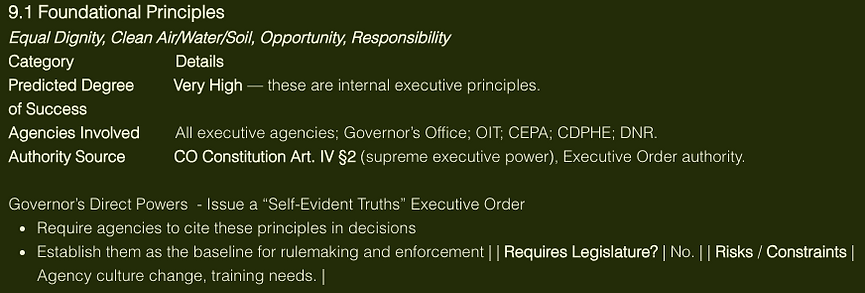


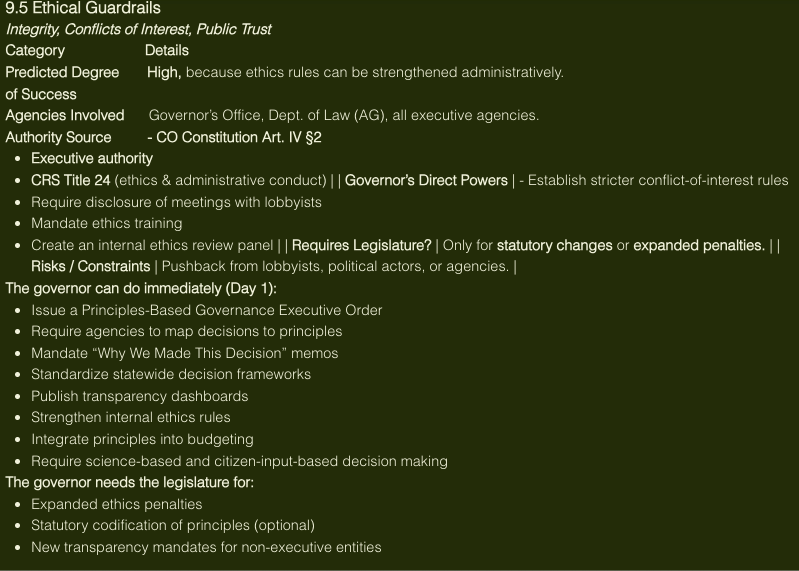
OPERATIONS AREA 10:
PROTECTING COLORADO’S SECURITY AND SOVEREIGNTY
Colorado is a co-sovereign state that cooperates with outside governments and entities where interests align, stands firm where they do not, and protects its people, institutions, and constitutional authority with quiet strength. We are living in times when we must and will, in the words of Theodore Roosevelt “Speak softly and carry a big stick”. While honoring the rule of law and civil liberties, Colorado needs to be prepared to defend itself against all enemies both foreign and domestic by establishing strong, strategic, preventive firewalls, legal, institutional, cyber, and OPERATIONS.
10.1 Principles for Colorado’s Security and Sovereignty
Colorado’s federal posture rests on four core principles:
Cooperation Where Beneficial
Work with federal agencies when it clearly benefits Coloradans.
Non-Commandeering
The federal government may not compel Colorado to enforce federal programs or priorities that conflict with state law, consistent with Supreme Court doctrine.
State Capacity to Protect
Colorado has a duty to protect its residents, institutions, and critical infrastructure from cyber, environmental, informational, and physical threats — without waiting passively on Washington.
Civil Liberties and Rule of Law
Security powers must be tightly bounded, transparent in structure, and subject to independent oversight.
This is not culture-war posturing. It is quiet, grown-up statecraft.
10.2 Legal Foundations & Firewalls Against Overreach
Colorado will strengthen its constitutional footing through clear statutory frameworks:
Colorado Sovereignty & Partnership Act
-
Codifies principles of cooperation, non-commandeering, and civil liberties.
-
Requires state agencies to decline enforcement of federal civil policies unless authorized by state statute.
-
Establishes procedures for when Colorado joins or declines federal initiatives.
Data & Privacy Firewalls
-
Limit sharing of state-held personal data with federal agencies unless required by law or court order.
-
Prohibit creation of state databases designed primarily for federal civil enforcement.
-
Protect schools, hospitals, and courthouses as “safe infrastructure zones” with tightly constrained data sharing.
Pre-Authorization for Constitutional Litigation
Empowers the Attorney General to rapidly challenge federal actions that:
-
commandeer state resources,
-
coerce the state through unlawful funding conditions, or
-
undermine Colorado’s environmental, health, or civil-rights protections.
Colorado’s message: We will be a strong partner, not a conscript.
10.3 National Guard Posture & State Defense (Within the Constitution)
The President may federalize the National Guard for specific missions, but governors retain substantial authority under state status. Colorado will maintain a Guard that is highly ready, lawful, and firmly rooted in civilian oversight.
Maintain a Highly Ready Guard Under State Control
-
Invest in training, equipment, and readiness for wildfire response, disaster relief, infrastructure protection, and cyber defense.
-
Use state active duty or Title 32 status where appropriate to keep command with the Governor while supporting federal missions.
Domestic Crisis Planning
Quietly prepare for scenarios requiring rapid, lawful Guard deployment to:
-
protect critical infrastructure and communications,
-
support civil authorities in emergencies,
-
secure key facilities from sabotage or violent unrest.
All plans will comply with Posse Comitatus and relevant state and federal law.
Guard Use Policy & Oversight
-
Publish clear principles for domestic deployment.
-
Require after-action reporting to the legislature for significant activations.
Colorado will not grandstand with the Guard. We will be ready, within the law.
10.4 Civilian Intelligence, Early Warning & Threat Analysis
Defending Colorado “against all enemies, foreign and domestic” is primarily about anticipation and resilience, not covert surveillance.
Colorado will establish a State Risk & Intelligence Coordination Center (SRICC) to:
Threat Fusion (Non-Covert)
Integrate information from:
-
state and local law enforcement,
-
emergency management,
-
public health,
-
environmental monitoring,
-
cyber incident reports,
-
open-source analysis of disinformation and extremist activity.
Produce regular threat assessments for critical infrastructure, elections, and major public events.
Early Warning Systems
Develop dashboards and alerts for:
-
cyber intrusions,
-
attempts to disrupt elections or public safety systems,
-
coordinated disinformation campaigns.
Strict Boundaries & Oversight
-
No mass or warrantless surveillance.
-
Focus on systems, not political beliefs or lawful speech.
-
Annual public summaries and legislative oversight.
This protects Colorado’s systems — not a secret police.
10.5 Cybersecurity & Critical Infrastructure Protection
Modern sovereignty depends on secure networks and resilient infrastructure.
Colorado Cyber Defense Office (CCDO)
Provide cybersecurity support and standards for:
-
state agencies,
-
counties and municipalities,
-
school districts,
-
public hospitals and utilities.
Conduct continuous training and red-team exercises.
Harden Critical Infrastructure
Prioritize protection for:
-
power grids and substations,
-
water systems,
-
emergency communications networks,
-
election systems,
-
transportation control systems.
Partner with private operators under agreements that protect civil liberties and data privacy.
Cyber Incident Response Ladder
Create clear triggers for:
-
technical assistance,
-
Guard or SRICC involvement,
-
federal coordination when needed.
Colorado’s goal: no single point of failure for the systems that keep people safe.
10.6 Unmanned Systems & Situational Awareness
Colorado will develop unmanned aerial and ground systems for:
-
wildfire detection and mapping,
-
flood and drought monitoring,
-
infrastructure inspection,
-
search and rescue,
-
disaster assessment,
-
perimeter security for critical facilities in emergencies.
-
Guardrails
-
No routine mass surveillance.
-
Clear statutory limits on law-enforcement use, with warrants where required.
-
Public reporting on categories of drone use.
-
Drones become tools of safety and stewardship, not intimidation.
10.7 Colorado State Resilience & Emergency Response Expansion (CS-RERE)
A civilian, outward-facing, infrastructure-protection and crisis-response system.
This system strengthens Colorado’s ability to respond to national emergencies, protect critical infrastructure, and deter coercive pressure — without militarizing policing.
Mission (Civilian, Constitutional, Non-Militarized)
-
critical infrastructure protection
-
disaster response
-
wildfire and environmental monitoring
-
cyber defense
-
search and rescue
-
interstate mutual aid
-
humanitarian logistics
-
aviation support
-
situational awareness during national crises
Specialized Civilian Units
Housed within a Colorado Critical Infrastructure & Emergency Response Division (CIERD):
-
Infrastructure Protection Unit
-
Aviation & Air Mobility Unit
-
Drone & Remote Sensing Unit
-
Rapid Humanitarian Response Teams
-
Cyber & Communications Resilience Unit
Civilian, Defensive Equipment
-
fire-resistant rescue vehicles
-
high-water flood vehicles
-
hardened communications vehicles
-
helicopters and fixed-wing aircraft for rescue and reconnaissance
-
environmental and thermal drones
-
hardened mobile command units
-
satellite uplink vehicles
Legal & Ethical Guardrails
-
Explicit ban on use for crowd control or domestic enforcement
-
Civilian oversight board
-
Annual public reporting
-
Strict warrant requirements for data collection
-
No military-grade weapons or tactical gear
-
Clear separation from state police operations
Interstate & Federal Crisis Support
Colorado becomes a regional stabilizer through:
-
wildfire aviation support
-
cyber mutual aid
-
disaster logistics
-
search and rescue
-
infrastructure protection teams
Deterrence through capability, not force.
10.8 Oversight, Civil Liberties & Nonpartisan Guardrails
Any expansion of state security capacity must be matched with equally strong protections.
10.9 Office of Homeland Security
According to the official state site, DHSEM handles:
-
Emergency management (wildfires, floods, blizzards)
-
Colorado Information Analysis Center (CIAC — the state fusion center)
-
Grants management
-
Public safety communications
-
State Emergency Operations Center
-
Disaster recovery
-
Cybersecurity support
-
Coordination with FEMA
Conclusion: Colorado will:
-
Create a Bipartisan Security & Civil Liberties Oversight Board to review SRICC, CCDO, Guard deployments, and advanced technologies.
-
Require annual public reports, independent audits, and clear complaint mechanisms.
-
Prohibit targeting individuals based on political beliefs, religion, race, or lawful advocacy.
-
Prohibit use of security tools for partisan goals.
-
Colorado’s message is simple: We will be strong, and we will be lawful. We will be prepared, and we will be accountable.
AUTHORITY
Governor = Commander-in-Chief of Colorado’s Military Forces
Colorado Constitution, Article IV, Section 5:
“The governor shall be commander-in-chief of the military forces of the state…”
This includes:
-
-
Colorado National Guard
-
Colorado State Patrol (under certain emergency conditions)
-
All state-controlled law enforcement during declared emergencies
This gives you broad authority over training, readiness, and equipment when tied to public safety or emergency preparedness.
Governor = Chief Executive Over All Executive Agencies
Colorado Constitution, Article IV, Section 2:
“The supreme executive power of the state shall be vested in the governor…”
This is the clause governors use to:
-
direct agencies
-
reorganize departments
-
set training standards
-
issue executive orders
-
mandate equipment upgrades
-
shift budget priorities (within appropriations)
This is your day-to-day OPERATIONS authority.
Colorado State Patrol is under the Department of Public Safety (DPS)
DPS is an executive branch agency, meaning:
-
The Governor appoints the Executive Director
-
The Governor can issue directives to DPS
-
The Governor can set policy priorities
-
The Governor can order training modernization
-
The Governor can require equipment upgrades (within budget)
This is your administrative authority.
Emergency Powers (Statutory) Expand Your Authority Further
Colorado Revised Statutes § 24-33.5-704:
During a declared emergency, the governor may:
-
“direct and compel the evacuation of all or part of the population”
-
“commandeer or utilize any private property if necessary”
-
“transfer the direction, personnel, or functions of state departments”
-
“procure… materials, medicines, and supplies”
This includes weapons, vehicles, communications systems, and training resources.
You don’t need an emergency to upgrade weapons — but if challenged, this is your failsafe authority.
Under Article IV, Section 2 of the Colorado Constitution, the ‘supreme executive power’ is vested in the governor. The State Patrol is an executive agency under the Department of Public Safety, whose director I appoint and direct.
Additionally, Article IV, Section 5 makes me commander-in-chief of Colorado’s military forces, which includes state law enforcement during emergencies.

Legal Firewalls: The Colorado Sovereignty & Partnership Act
-
The Action: Codify the "Non-Commandeering" doctrine into state law to prevent federal "conscription" of state employees (e.g., local police or health workers) for federal civil priorities.
-
Primary Agency: Department of Law (Attorney General) and Governor’s Legal Counsel.
-
The Mechanism: Establish a "Sovereignty Review" process for all federal Grant Agreements. If a federal grant requires Colorado to share sensitive resident data (outside of criminal warrants) or enforce federal civil mandates, the Attorney General is authorized to issue a "Non-Compliance Shield."
-
The "Safe Infrastructure" Rule: Direct DOLA and CDPHE to certify schools and hospitals as "Sensitive Locations." State data systems for these facilities will be physically or logically air-gapped from federal civil enforcement databases.
National Guard Posture: "The Colorado First" Doctrine
The Action: Transition the Colorado National Guard (CONG) from a purely federal reserve to a highly specialized State Resilience Force capable of domestic stabilization.
-
Primary Agency: Department of Military and Veterans Affairs (DMVA).
-
Command Authority: Utilize Title 32 U.S.C. § 502(f). This allows the Governor to keep command and control (and bypass the Posse Comitatus Act) while the federal government pays for missions that serve both state and national interests (e.g., cyber defense of the power grid).
-
State Active Duty (SAD) Reform: Create a dedicated "State Emergency Pay Scale" to ensure Guard members are not financially penalized when called by the Governor for wildfire or infrastructure defense.
-
The "Big Stick" Readiness: Establish a permanent Critical Infrastructure Protection (CIP) unit within the Guard, trained specifically to secure water treatment plants and electrical substations during periods of civil unrest or cyberwarfare.
The State Risk & Intelligence Coordination Center (SRICC)
The Action: Evolve the existing Colorado Information Analysis Center (CIAC) into a modern, civilian-overseen "Threat Fusion" center.
-
Primary Agency: Department of Public Safety (DPS) / DHSEM.
-
The Innovation: Move beyond "crime stats" to "Systemic Risk Analysis." The SRICC will analyze non-classified, open-source data to identify:
-
Coordinated Disinformation: Foreign or domestic campaigns targeting Colorado’s elections or public health systems.
-
Infrastructure Fragility: Real-time monitoring of "single points of failure" in the state’s digital and physical networks.
The Oversight Firewall: Create a Bipartisan Civil Liberties Board with the power to audit SRICC data logs. This ensures the center monitors threats to systems, not political beliefs.

Cybersecurity: The "No Single Point of Failure" Policy
The Action: Hardening the digital "spine" of the state.
-
Primary Agency: Office of Information Technology (OIT) / Colorado Cyber Defense Office.
-
The "Red-Team" Mandate: OIT will conduct quarterly, unannounced "penetration tests" on county election systems and rural water districts.
-
The 2026 "Cyber-Shield" Grant: Divert $15M in state resilience funds to provide Zero-Trust Architecture upgrades for municipal utilities.
Strategic Narrative: "The Sovereign Shield"
"Colorado is not an island, but it is a home. We will cooperate with the federal government as partners, but we will never be their conscripts. Whether the threat is a wildfire, a cyberattack, or federal overreach, Colorado will have its own eyes, its own shield, and its own plan. We speak softly because we are prepared—and we carry a big stick because we love our state."
Final High-Value Next Step
Would you like me to draft a "Notice of Non-Commandeering" template? This is the document your Cabinet members would issue to federal counterparts if a request is made that violates Colorado’s 2026 Sovereignty & Partnership Act.
EDUCATION & HUMAN DEVELOPMENT
Colorado’s future depends on the strength, safety, and integrity of its public education system. This operations Area establishes a statewide doctrine of universal public education, human development, and school safety, grounded in global best practices and Colorado values. We reject privatization schemes that siphon public funds. Public dollars must serve the public good — not private institutions that choose their students, set their own rules, and answer to no one. We invest in people — students, teachers, and communities — to build a system that teaches not just academics, but how to be a person in society. Colorado will build the most advanced public education system in the United States — academically, socially, and in safety. Implementing these changes in 2026 requires dismantling the "competitive marketplace" model of education and replacing it with a Public Service Excellence model. With Colorado currently ranking near the bottom in teacher salary competitiveness (despite recent gains), the "10% Leadership Premium" is the administration's most aggressive fiscal lever.
11.1 Foundational Principles
-
Public education is a public good.
-
No state money for private or voucher schools.
-
Schools must teach academics and humanity.
-
Safety is non-negotiable.
-
Teachers are professionals — and paid accordingly.
-
Education is preparation for life, not just tests.
-
Every child deserves to feel safe, supported, and seen — every single day.
11.2 Public Education Doctrine
No Vouchers, No Subsidized Private Schools
-
Private schools may exist, but not on the public dime.
-
All state education funds go to public systems only.
-
Public dollars must serve the public good.
Universal Public School Access
-
Every child in Colorado has a right to a high-quality public education.
-
No lotteries, no barriers, no tiered systems.
-
Schools are community anchors, not competitive marketplaces.
11.3 Curriculum Reform: Teaching People How to Be People
Colorado will adopt a curriculum modeled on the most successful systems in the world — Finland, Singapore, Japan, and Canada — with a uniquely Colorado emphasis on civic responsibility and human development.
Required Courses Statewide
-
Life Skills — budgeting, nutrition, conflict resolution, digital literacy
-
Civics & Ethics — constitutional rights, civic duties, ethical reasoning
-
Self-Care & Mental Health — emotional regulation, stress management, peer support
-
Career & Technical Education — trades, entrepreneurship, real-world pathways
-
Environmental Stewardship — land, water, and climate literacy
-
11.3.1 Universal Early Childhood Access
-
State-funded pre-K for all families
-
Developmental screening and early intervention
-
Parent support programs
-
Evidence-based early learning standards
Early childhood education is the foundation of every high-performing system in the world.
11.4 School Safety Doctrine
Colorado will lead the nation in school safety through prevention, detection, and rapid response — with strict privacy protections and transparent oversight.
Weapons Ban on School Property
-
Guns and knives banned from all school grounds.
-
First offense: automatic felony referral or maximum legal suspension.
-
Statewide legal framework pursued to codify this.
Advanced Threat Detection Systems
-
AI-powered surveillance, entry screening, and behavioral anomaly detection.
-
Privacy-protected, independently audited, and publicly reported.
-
Funded through a dedicated school safety allocation.
“See Something, Say Something, Do Something” Campaign
-
Mandatory training for students and staff.
-
Anonymous reporting tools.
-
Immediate response protocols.
School Marshals Program
-
State Police officers assigned to schools.
Trained in:
-
Close-quarters combat
-
Threat detection
-
De-escalation
-
Emergency medical response
Modeled on Secret Service and Air Marshall programs.
Mission: de-escalate first, neutralize when necessary.
11.5 Teacher Pay, Pipeline & Professionalization
Nation-Leading Pay + 10%
-
Colorado teachers will be the highest-paid in the nation — plus 10%.
-
Indexed annually to maintain leadership.
Master’s-Level Credentialing Standard
-
Following Finland’s model: all teachers must hold or pursue a master’s degree.
-
State-funded pathways to credentialing.
Teacher Pipeline & Retention
-
Mentorship programs for new teachers
-
Leadership pathways for experienced educators
-
Reduced standardized testing
-
Increased planning time and support staff
Colorado will build a teacher pipeline that attracts, trains, and retains the best educators in the nation.
11.6 Governance, Accountability & Oversight
Colorado Education Integrity Office
-
Independent watchdog for curriculum integrity, safety compliance, and equity enforcement.
Public Education Dashboard
Transparent data on:
-
School safety
-
Teacher pay
-
Student outcomes
-
Mental health indicators
-
Civic engagement metrics
School Accountability Report Cards
-
Annual public reports for every school
-
Safety, academic, and well-being metrics
-
Clear, accessible, and standardized statewide
11.7 Narrative for Coloradans
“Colorado will build the most principled, people-centered public education system in the country. We will teach our children how to think, how to care, how to participate, and how to stay safe. We will pay our teachers like the professionals they are. We will protect every child’s right to a safe, supportive, and dignified learning environment. And we will never let private interests siphon public dollars away from the future of our state.”
AUTHORITY AND METHOD
Colorado’s future depends on the strength, safety, and integrity of its public education system. The governor cannot micromanage classrooms, but can set doctrine, drive funding priorities, shape safety, and create statewide supports that move the entire system. Below is the authority breakdown for your existing sections 11.1–11.7.


EQUAL DIGNITY, INCLUSION & ACCESS
Colorado’s strength comes from its people — all of them. A society with Colorado’s resources has a responsibility to ensure that every person can participate fully, regardless of disability, background, or difference. This OPERATIONS Area establishes a statewide doctrine of equal dignity, equal access, and developmental responsibility. Colorado will pursue inclusion without ideology, support without coercion, and respect for adolescent development without medical intervention. This framework is grounded in human development science, civil rights principles, and Colorado’s values of fairness, responsibility, and community.
12.4 Adolescent Identity Development: Support, Not Intervention
Research shows that adolescence is a period of exploration — emotional, social, and identity-based. This is normal human development.
Colorado’s policy will reflect that:
-
Identity exploration is not a disability
-
It is not a medical condition
-
It does not require state-sponsored medical intervention
-
It does require support, listening, and guidance
Colorado’s Approach
-
Schools will provide qualified counselors trained in adolescent development
-
Students can access confidential, supportive conversations
-
Parents will be engaged respectfully and transparently whenever appropriate
-
Schools will not diagnose, label, or direct students toward medical pathways
-
Schools will not withhold information from parents unless safety is at risk
-
Schools will not pressure students toward any identity or ideology
This is a supportive, non-medical, developmentally appropriate model.
12.5 Self-Health & Human Development Programming
Identity exploration, emotional regulation, and social development will be integrated into the statewide self-health curriculum:
-
Emotional literacy
-
Stress management
-
Healthy relationships
-
Self-awareness
-
Boundary-setting
-
Respect for others
-
Understanding developmental stages
-
Navigating identity questions without pressure
Students will learn how to understand themselves without being pushed toward any particular identity or ideology.
12.6 School Counseling Expansion
Colorado will significantly expand school-based counseling:
-
Lower student-to-counselor ratios
-
Training in adolescent development, identity exploration, emotional regulation, and family engagement
-
Crisis support and referral pathways
-
Confidential, non-judgmental spaces for students to talk
-
Clear boundaries between counseling and medical decision-making
Counseling is support — not diagnosis, not treatment, not ideology.
12.7 Workforce & Public Sector Inclusion
Colorado will ensure equal access and opportunity in state employment:
-
Anti-discrimination enforcement
-
Accessibility accommodations
-
Inclusive hiring pipelines
-
Leadership development for underrepresented groups
-
Transparent promotion pathways
This is inclusion based on opportunity, not ideology.
12.8 Narrative for Coloradans
Colorado believes in equal dignity for every person. We will build a society where disability is not a barrier, where differences are respected, and where every child has access to support and guidance. We will not politicize identity or push children toward irreversible decisions. Instead, we will provide counseling, compassion, and a developmentally responsible environment where young people can grow, explore, and become themselves — safely, responsibly, and with the support of their families and communities. In 2026, implementing OPERATIONS AREA 12 requires a sophisticated navigation of Colorado’s existing "Shield Laws" (passed in 2023) and the new federal landscape. The goal is to move from identity-based politics to a human development model that prioritizes structural access for the disabled and developmental neutrality for the young.
AUTHORITY AND METHODS
Executive Order: The Universal Design & Accessibility Mandate
EO Number: D 2026-022
Title: Achieving Full Participation through Universal Design and ADA Excellence
WHEREAS, true inclusion begins with the physical and digital environment; and
WHEREAS, Colorado law (HB21-1110) requires all government digital entities to meet WCAG 2.1 AA standards by 2025/2026;
I hereby order the following:
-
The "Front Door" Accessibility Audit: Every state agency must certify by June 2026 that their primary public-facing service points (physical and digital) exceed ADA minimums, utilizing Universal Design (designing for the most challenged user to benefit all).
-
State Workforce Inclusion: The Department of Personnel & Administration (DPA) shall eliminate "degree inflation" for state jobs that can be performed with equivalent experience, opening pathways for those with learning differences or non-traditional backgrounds.
-
Assistive Tech Revolving Fund: Establish a $10M fund to provide small businesses with low-interest loans to implement accessibility upgrades (ramps, sensory-friendly lighting, or screen-reading software).
Operational Guide: The "Developmental Neutrality" Standard
To: Colorado Department of Education (CDE) / School District Boards
Subject: Guidance on Adolescent Identity and Parental Partnership
To move past the "culture war" of 2024-2025, Colorado schools will adopt a Counseling-First, Intervention-Last posture.
I. The Neutrality Principle
-
No Compelled Labels: Schools and state agencies are prohibited from requiring students or employees to adopt specific ideological frameworks or "identity labels" as a condition of participation.
-
The "Supportive Wait" Protocol: In alignment with international best practices (Finland/UK), school-based support for identity exploration will focus on psychosocial counseling and "watchful waiting" rather than directing minors toward medical pathways.
II. Parental Transparency
-
The Partnership Rule: Parents are the primary stakeholders in their child’s development. Schools must maintain a "rebuttable presumption of notification" for any significant change in a student's well-being or social transition, unless there is a documented, specific threat of physical harm at home (verified by a threat assessment team).
Policy Brief: The Counseling Expansion & Ratio Target
Area 12 Accountability Metrics

Strategic Narrative: "The Dignity of the Person"
"In Colorado, we don't put people in boxes. We give them the tools to build their own lives. Whether you are navigating a world not built for your wheelchair, or an adolescence filled with complex questions, this state is your partner—not your parent, and certainly not your ideologue. We offer dignity, we offer access, and we offer the time and space to grow into the person you were meant to be."
Colorado’s diversity is a strength — but only if every Coloradan can safely participate in public life. This OPERATIONS Area establishes a non-ideological, dignity-first framework that protects people with disabilities, supports teens, ensures equal access, and strengthens inclusion without culture-war rhetoric.
Below is the authority breakdown for your existing sections.


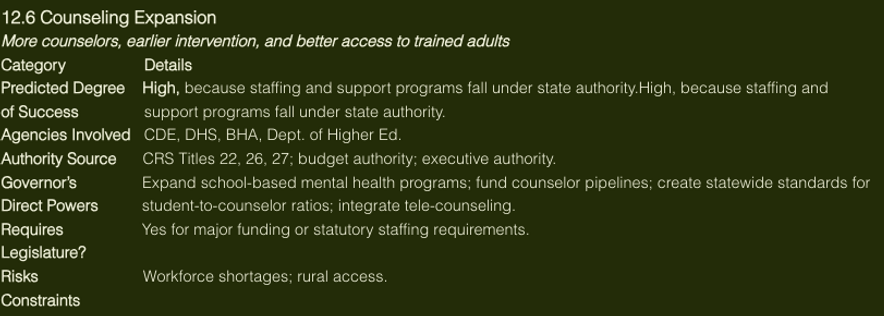


The governor can do immediately (Day 1):
-
Issue an Equal Dignity Executive Order
-
Strengthen disability access enforcement
-
Set statewide inclusion-without-ideology standards
-
Expand school counseling and youth support
-
Launch self-health curriculum pilots
-
Require nondiscrimination in state contracts
-
Build statewide inclusion dashboards
-
Frame inclusion as dignity, safety, and opportunity
The governor needs the legislature for:
-
Major funding for counselors and disability upgrades
-
Statutory nondiscrimination expansions
-
Statewide curriculum mandates
-
New penalties or enforcement tools
OPERATIONS AREA 13:
VETERANS, SERVICE MEMBERS & MILITARY FAMILIES
Colorado is home to one of the largest and most diverse veteran populations in the country. Veterans consistently report that their top concerns mirror those of the broader public — but with heightened urgency: trust in government, cost of living, election integrity, and public safety. This operations Area is built directly from veteran-reported priorities, not assumptions. Colorado will honor veterans not with slogans, but with competent governance, stable institutions, and practical support that strengthens their families and communities.
13.1 Foundational Principles
-
Veterans deserve a government worthy of their service.
-
Civic duty continues after military service — and the state must support it.
-
Stability, integrity, and affordability are the pillars of veteran well-being.
-
Veteran policy must be practical, non-partisan, and grounded in real needs.
-
Military families deserve predictable systems and clear communication.
13.2 Cost of Living Relief for Veterans
Polling shows inflation and cost of living are top concerns for veterans.
Colorado will:
-
Expand property tax exemptions for disabled veterans
-
Provide targeted cost-of-living relief for veteran households
-
Prioritize veterans in affordable housing programs
-
Ensure veterans have access to state healthcare subsidies when federal coverage is insufficient
-
Create a “Veteran Cost Stability Dashboard” to track prices, housing, and benefits
Veterans should not struggle to afford the state they served.
13.3 Election Integrity & Civic Participation
Veterans overwhelmingly believe voting is a civic duty and an extension of their oath.
Colorado will:
-
Guarantee secure, transparent, auditable elections
-
Expand ballot access for deployed service members and veterans who relocate frequently
-
Strengthen absentee ballot systems for military families
-
Create a “Veterans Civic Access Hotline” for voting questions
-
Recruit and train veterans as poll workers to increase public trust
Veterans want elections to be safe, confidential, and trustworthy — and Colorado will deliver.
13.4 Public Safety & Community Stability
Veterans rank public safety and immigration among their top concerns.
Colorado will:
-
Ensure predictable, non-partisan public safety policies
-
Strengthen coordination between state agencies and federal partners
-
Expand crisis response programs for veterans experiencing mental health emergencies
-
Support veteran-led community safety initiatives
Veterans want stability — not chaos — in their communities.
13.5 Employment, Skills & Economic Mobility
Veterans bring unmatched skills, discipline, and leadership.
Colorado will:
-
Expand veteran hiring pipelines in state government
-
Recognize military training for civilian credentials
-
Create fast-track pathways for veterans in healthcare, emergency response, and skilled trades
-
Provide entrepreneurship support for veteran-owned businesses
-
Offer relocation assistance for veterans moving to Colorado for work
Veterans should be able to build strong, stable careers without unnecessary barriers.
13.6 Mental Health, Peer Support & Family Stability
While polling highlights cost of living and democracy as top issues, veterans also consistently report the need for accessible, stigma-free support.
Colorado will:
-
Expand peer-to-peer veteran support networks
-
Increase access to counseling and crisis services
-
Strengthen partnerships with VA facilities
-
Provide family support programs for spouses and children
-
Ensure veterans can access state mental health resources without bureaucratic hurdles
Support must be practical, immediate, and respectful.
13.7 Housing Stability for Veterans
Veterans face unique housing challenges, especially during transitions.
Colorado will:
-
Prioritize veterans in Housing First programs
-
Expand rental assistance for veteran families
-
Increase transitional housing for veterans leaving active duty
-
Coordinate with federal programs to prevent homelessness
-
Provide legal and financial counseling for at-risk veterans
No veteran should be homeless in Colorado.
13.8 Narrative for Coloradans
“Colorado will honor veterans not with slogans, but with competence. Veterans want stable institutions, trustworthy elections, affordable living, and a government that keeps its word. We will deliver a Colorado where veterans and their families can thrive — with dignity, stability, and the respect they earned through service.”
Honor, stability, dignity, and lifelong support


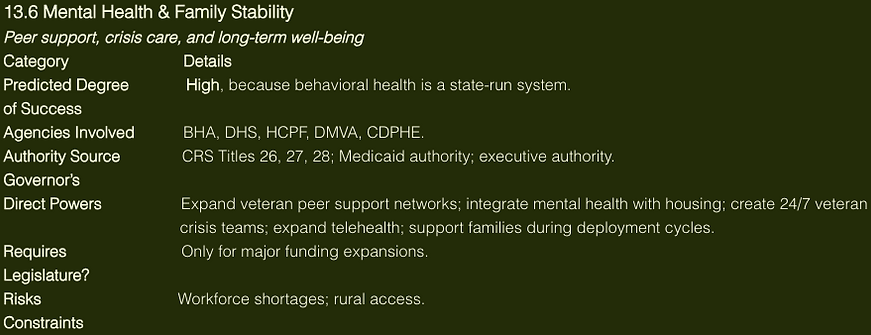


The governor can do immediately (Day 1):
-
Issue a Veterans & Military Families Doctrine
-
Expand veteran housing and crisis services
-
Strengthen military voting access
-
Launch veteran job pipelines and credential recognition
-
Expand peer support and mental health services
-
Direct DPS to protect military families facing crisis
-
Coordinate Guard support for emergencies
-
Build statewide dashboards for veteran outcomes
The governor needs the legislature for:
-
New tax credits or benefits
-
Major housing or mental health funding
-
Statutory hiring preferences
-
Expanded election mandates
-
Dedicated funding for a Veterans Housing Fund
In 2026, Colorado’s veteran population (approx. 400,000) is a critical pillar of the state's workforce and civic life. Implementing OPERATIONS AREA 13 requires shifting from "benefits processing" to "economic and civic integration."
The primary operational authority rests with the Department of Military and Veterans Affairs (DMVA) and the Division of Veterans Affairs.
Strategic Narrative: "The Living Oath"
"In Colorado, the oath of service doesn't expire when you hang up the uniform—and the state's obligation to you doesn't either. We won't give you a parade and then let you be priced out of your home. We will give you a government that works as hard as you did, elections you can trust, and a clear path to your next mission in our workforce."
OPERATIONS AREA 14:
CORPORATE ACCOUNTABILITY & ECONOMIC FAIR PLAY
Colorado’s economy depends on businesses — but not on corporate capture, loopholes, or threats to leave the state whenever accountability is mentioned. This OPERATIONS Area establishes a modern doctrine of fair play, transparency, and economic sovereignty, using both incentives and consequences to ensure corporations contribute to Colorado’s long-term stability. Colorado will be a state where businesses can thrive — but only if they play by the rules, respect the environment, and contribute to the communities that make their profits possible.
14.1 Foundational Principles
-
Corporations benefit from Colorado’s land, people, infrastructure, and stability — and must contribute accordingly.
-
Economic development must serve the public good, not corporate leverage.
-
Accountability is pro-business when it creates a level playing field.
-
Colorado will use both incentives and consequences to shape corporate behavior.
-
No corporation is entitled to extract wealth from Colorado without giving back.
14.1.1 Human-Centered Governance Principle
Government serves the people of Colorado. Corporations are legal entities made up of people, and we protect the people — not the entity itself. No corporation will ever receive rights, privileges, or protections that supersede the public interest.
14.2 The Carrot: Incentives for Good Corporate Behavior
Colorado will reward companies that:
A. Create Good Jobs
-
Living-wage jobs
-
Benefits
-
Predictable scheduling
-
Worker training pipelines
B. Reduce Environmental Harm
-
Verified emissions reductions
-
Zero violations for 3+ years
-
Investments in clean technology
-
Participation in CEPA compliance programs
C. Invest in Colorado Communities
-
Local hiring
-
Apprenticeships
-
Support for schools and workforce programs
-
Infrastructure partnerships
D. Demonstrate Long-Term Commitment
-
10+ year presence
-
Transparent reporting
-
No history of “incentive shopping”
Incentives include:
-
Priority access to state contracts
-
Fast-track permitting
-
Reduced regulatory friction
-
Public recognition as a “Colorado Fair Play Corporation”
-
Access to state-backed financing for expansion
These incentives are earned — not given.
14.3 The Stick: Consequences for Corporate Misconduct
Colorado will be the first state to adopt a Corporate Responsibility Enforcement Framework with real teeth.
14.3.1 The Colorado Cleanup Doctrine
If you make a mess, you clean it up. If you made a mess, you clean it up — and you do not get to leave Colorado until you do. Corporations must fully remediate environmental, financial, and community harm before relocating, dissolving, or downsizing. The state may block exit or impose escalating penalties until obligations are met.
A. Leaving Colorado Comes With a Cost
If a corporation takes public incentives, then leaves or downsizes within a defined period:
-
Mandatory repayment of incentives
-
Penalties for job destruction
-
Loss of eligibility for future incentives
-
Public disclosure of breach
B. Environmental Violations Trigger Automatic Consequences
-
Daily escalating fines
-
Permit suspension
-
Criminal referral for repeated violations
-
Executive accountability provisions
-
State takeover of cleanup if necessary
C. Anti-Extraction Rules
Corporations that extract wealth without reinvesting in Colorado face:
-
Higher tax rates on profits exported out of state
-
Fees for excessive land or water use
-
Penalties for speculative land banking
D. Anti-Monopoly & Anti-Gouging Enforcement
Colorado will aggressively enforce:
-
Price gouging laws
-
Anti-monopoly statutes
-
Anti-collusion rules
-
Consumer protection standards
The message is simple: If you harm Colorado, Colorado will respond.
14.4 The Shield: Protecting Colorado From Corporate Leverage
Corporations often threaten to leave states to extract concessions. Colorado will end this dynamic.
A. No More Corporate Hostage-Taking
Colorado will not negotiate under threat.
B. Public Transparency for All Incentive Deals
All deals must be:
-
Public
-
Audited
-
Justified
-
Performance-based
C. Multi-State Compacts
Colorado will pursue compacts with neighboring states to:
-
End the “race to the bottom”
-
Prevent incentive wars
-
Standardize corporate accountability
This removes the leverage corporations use to play states against each other.
14.5 The Anchor: Why Corporations Will Stay Anyway
Even with strong accountability, Colorado remains one of the most attractive states in the country because of:
-
A highly educated workforce
-
World-class universities
-
Outdoor lifestyle and quality of life
-
Clean energy leadership
-
Water and climate innovation
-
Stable governance
-
Strong infrastructure
-
Predictable regulatory environment
Corporations stay where the talent is — and Colorado’s talent is not going anywhere.
14.6 The Colorado Corporate Compact
Every corporation operating in Colorado will be invited to sign a voluntary compact committing to:
-
Fair wages
-
Environmental compliance
-
Community investment
-
Transparency
-
Long-term presence
Those who sign receive public recognition and priority access to state partnerships.
Those who refuse are simply held to the law.
AUTHORITY AND METHODS
Colorado’s economy works only when companies play by the rules, protect the environment, pay fair wages, and invest in the communities that make their profits possible. This OPERATIONS Area establishes a balanced, pro-worker, pro-community, pro-fair-competition framework that rewards responsible businesses and holds bad actors accountable. Below is the authority breakdown for Sections 14.1 through 14.7.


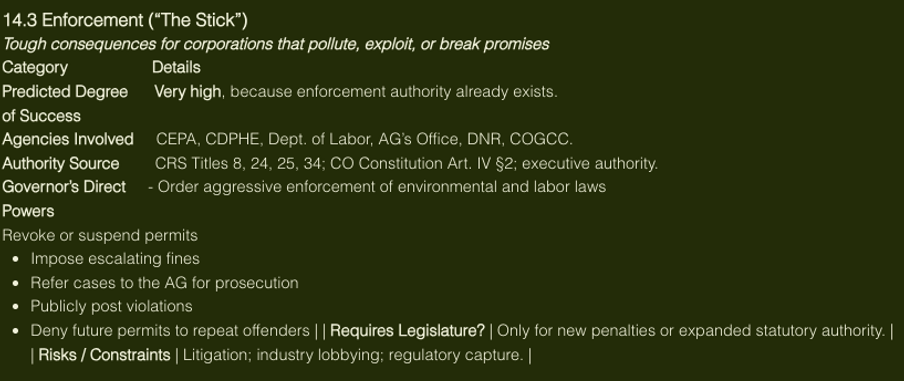


The governor can do immediately (Day 1):
-
Issue a Corporate Fair Play Doctrine
-
Tie incentives to wages, environmental compliance, and community benefit
-
Enforce environmental and labor laws aggressively
-
Require clawbacks in all incentive agreements
-
Launch the Colorado Corporate Compact
-
Publicly post corporate violations
-
Deny permits to repeat offenders
-
Require community benefit agreements for major projects
The governor needs the legislature for:
-
New penalties or expanded enforcement authority
-
Major tax credit reforms
-
Increased bonding requirements
-
Statutory clawback expansions
Implementing OPERATIONS AREA 14 requires shifting Colorado’s economic posture from "passive host" to "active partner." In 2026, the state will leverage its high-value talent pool and a new suite of accountability laws—including the landmark HB 25-1090 (Deceptive Pricing) and SB 24-205 (AI Accountability)—to ensure corporations contribute more than they extract.

The Carrot: Rewarding the "Colorado Fair Play" Corporation
The Action: Redesign state procurement and incentives to favor companies that prioritize "Long-Term Commitment" and "Employee Ownership."
-
Employee Ownership Advantage: As of January 1, 2026, OEDIT offers tax credits covering up to 75% of conversion costs (up to $150k) for companies transitioning to ESOPs. This "anchors" corporations by making workers the owners.
-
The "Living Wage" Preference: All state contracts will include a weighted scoring system that rewards bidders paying at least 110% of the local median wage.
-
Fast-Track Permitting: Companies with a 3+ year record of zero CDPHE environmental violations gain "Green Path" status, reducing regulatory wait times by 50%.
The Stick: The Colorado Cleanup & Exit Doctrine
The Action: Implement statutory "Clawbacks" and "Remediation Holds" to prevent corporations from leaving behind environmental or economic voids.
I. Environmental "Remediation Holds" (CDPHE)
Under the 2026 Cleanup Doctrine, corporations with active environmental footprints (mining, energy, manufacturing) are prohibited from dissolving or transferring Colorado assets until a Remediation Surety Bond is fully funded.
-
The Suncor/Exxon Precedent: Leveraging the 2025 Supreme Court victory for Boulder County, the state will aggressively pursue "fair share" payments for climate-impacted infrastructure.
II. Mandatory Incentive Repayment (OEDIT)
If a company receives state tax credits or "Job Growth Incentive Tax Credits" and relocates out of state within 5 years:
-
The Trigger: Automatic audit by the Department of Revenue.
-
The Penalty: 100% repayment of all state subsidies received, plus a 15% "Community Disruption Fee" to fund local worker retraining.
Anti-Monopoly & Pricing Integrity
The Action: Combatting "Corporate Capture" through aggressive consumer protection.
-
Deceptive Pricing Enforcement: Per HB 25-1090, effective January 1, 2026, the AG will pursue civil penalties against any firm using "drip pricing" (hidden fees). The law mandates Clear "Total Price" Disclosures upfront.
-
Antitrust "Roll-Up" Prevention: The 2023 Antitrust Act allows the AG to block "serial acquisitions" (small mergers that collectively create a monopoly), with maximum per-violation civil penalties increased to $1 million.
AUTHORITY AND METHODS

Strategic Narrative: "A Fair Deal for a Great State"
"Colorado is a partner in your success—we provide the educated workforce, the clean water, and the stable infrastructure you use to build your business. In return, we ask for a fair deal. No more hidden fees, no more exported profits, and no more abandoned sites. If you invest in Colorado, we will clear the path for you. If you extract from Colorado, we will ensure you leave our state as clean and strong as you found it.
"This consolidated Authority and Operational Blueprint for OPERATIONS AREA 14: CORPORATE ACCOUNTABILITY & FAIR PLAY integrates your foundational principles with the specific gubernatorial and statutory powers of 2026. It ensures that every action—from deceptive pricing enforcement to worker-ownership transitions—is anchored in the Colorado Constitution and the landmark consumer protections enacted in 2024 and 2025.

14.2 The "Carrot": Incentivizing the Colorado Way
Objective: Reward companies that anchor themselves in Colorado through fair wages and employee
ownership.
-
Executive Action 14.2.1: Employee Ownership Expansion. Direct OEDIT to implement HB 25-1021, offering tax credits that cover 75% of conversion costs (up to $150,000) for businesses transitioning to ESOPs or Cooperatives as of January 1, 2026. [Authority: HB 25-1021; C.R.S. Title 24]
-
Executive Action 14.2.2: The "Living Wage" Procurement Preference. Mandate a weighted scoring system for all state contracts that awards a 20% preference to bidders paying at least 110% of the local median wage. [Authority: Supreme Executive Power]
-
Executive Action 14.2.3: Green-Path Permitting. Direct CDPHE to fast-track permits for companies with a 3-year history of zero environmental violations, effectively cutting regulatory wait times by 50%. [Authority: C.R.S. Title 25]
14.3 The "Stick": The Cleanup & Accountability Doctrine
Objective: Hold bad actors accountable for "greedflation," "junk fees," and environmental abandonment.
-
Executive Action 14.3.1: Deceptive Pricing Crackdown. Direct the AG to enforce HB 25-1090, which bans "drip pricing" (hidden fees) and mandates a single "Total Price" disclosure for all consumer goods and residential leases as of Jan 1, 2026. [Authority: HB 25-1090; Consumer Protection Act]
-
Executive Action 14.3.2: Anti-Monopoly "Roll-Up" Prevention. Utilize the 2023 Antitrust Act to investigate serial acquisitions that create local monopolies, with civil penalties now at $1 Million per violation. [Authority: Colorado State Antitrust Act of 2023]
-
Executive Action 14.3.3: AI Accountability Enforcement. Direct the AG to enforce SB 24-205, requiring "High-Risk AI" developers to protect consumers from algorithmic discrimination in housing, lending, and hiring. [Authority: SB 24-205; Effective Feb 1, 2026]
14.4 Shielding Colorado: The Exit & Tax Firewall
Objective: Prevent profit exportation and the abandonment of remediation responsibilities.
-
Executive Action 14.4.1: Unitary Tax Reporting. Direct the Department of Revenue to implement Combined Reporting for all unitary businesses in 2026, ensuring corporations pay taxes based on their actual economic activity in Colorado, regardless of where they are domiciled. [Authority: HB 24-1134]
-
Executive Action 14.4.2: Remediation Surety Bonds. Prohibit corporations in high-impact industries (mining, energy) from transferring assets until a full Remediation Surety Bond is funded to cover 100% of cleanup costs. [Authority: C.R.S. Titles 25 & 34]
-
Executive Action 14.4.3: Strategic Clawbacks. Mandate that all OEDIT incentives include a 5-year residency requirement. Companies that relocate out of state must repay 100% of subsidies plus a 15% Community Disruption Fee. [Authority: Contract Law; OEDIT Policy]
14.5 Area 14 Accountability Dashboard (2026)

14.6 Risks, Constraints & Barriers
-
Litigation on Price Transparency: National retailers may challenge HB 25-1090's "Total Price" mandate. Mitigation: Rely on the Colorado Consumer Protection Act's long-standing authority to prevent deceptive trade practices.
-
Corporate Relocation Threats: High accountability may lead some to threaten exit. Mitigation: Lean into the "Colorado Compact"—highlighting the state's stability, workforce talent, and quality of life as a premium value that far outweighs the cost of compliance.
OPERATIONS AREA 15:
REVENUE GENERATION & ECONOMIC SOVEREIGNTY
Colorado’s revenue system is constrained by TABOR and structural limits. A governor must be creative, aggressive, and strategic to fund priorities without raising income taxes. This OPERATIONS Area outlines the most viable revenue strategies.
15.1 Colorado’s Revenue Constraints
-
TABOR caps
-
Refund requirements
-
Thin General Fund
-
Heavy reliance on income tax
Colorado must diversify revenue.
15.2 Expand State Parklands + Increase Park Fees
-
High demand
-
Underpriced access
-
TABOR-friendly (fees, not taxes)
-
Funds conservation and infrastructure
15.3 Sell State Tax Credits for Immediate Cash
Colorado already does this.
Expand to:
-
Insurance premium tax credits
-
Corporate income tax credits
-
Affordable housing credits
-
Conservation easement credits
15.4 Expand Charges for Services
TABOR-friendly.
Includes:
-
Licensing fees
-
Park passes
-
Hunting/fishing permits
-
Vehicle registration
-
Court filing fees
-
Business registration
-
Tourism fees
15.5 New Excise Taxes
-
Sports betting
-
Online gambling
-
Luxury goods
-
Short-term rentals
-
Sugar-sweetened beverages
-
Firearms/ammunition (politically difficult but lucrative)
15.6 State-Owned Revenue-Generating Assets
Colorado can own:
-
Broadband infrastructure
-
Energy transmission lines
-
Housing developments
-
Water recycling facilities
-
Retirement communities
-
Childcare centers
These generate ongoing revenue.
15.7 Public Investment Fund
Seeded by:
-
Tax credit sales
-
Federal grants
-
Surpluses
-
Enterprise fees
Invests in:
-
Real estate
-
Infrastructure
-
Bonds
-
Equities
-
Colorado businesses
15.8 Reform Tax Expenditures
Colorado loses billions through:
-
Corporate exemptions
-
Sales tax exemptions
-
Property tax breaks
-
Special interest carve-outs
Reforming even 10% yields major revenue.
15.9 Modernize Sin Taxes
-
Tobacco
-
Vaping
-
Alcohol
-
Gambling
Politically viable.
15.10 Attract High-Income Residents & Businesses
Revenue grows when incomes grow.
Strategies:
-
Relocation incentives
-
Innovation districts
-
Film/media tax credits
-
Startup zones
-
Fast-track permitting
15.11 Monetize State Lands
Lease land for:
-
Renewable energy
-
Data centers
-
Recreation
-
Agriculture
-
Film production
-
Events
Massive potential.
15.12 Expand Lottery & Gaming Revenue
-
Online lottery
-
Digital instant-win games
-
New gaming districts
-
State-run sports betting
15.13 Colorado Infrastructure Bank
Finances:
-
Housing
-
Water
-
Broadband
-
Transportation
Charges interest and reinvests profits.
15.14 Tourism Revenue
-
Tourism impact fees
-
State-run attractions
-
Park and trail fees
-
State-run lodging
-
Festivals and events
15.15 Federal Grant Capture
Colorado leaves money on the table.
Create:
-
Federal Funding Capture Office
-
Multi-year project pipelines
-
Maximized Medicaid matching
-
Aggressive pursuit of infrastructure and education grants
15.16 SkyCarbon Economic Strategy
Pillars
-
Carbon industry build-out
-
State financing tools
-
Carbon-based products
-
Federal leverage
-
Regional interstate alliance
DACR Becomes A Core Economic Engine.
-
High-skill jobs
-
Manufacturing growth
-
Rural revitalization
-
Federal funding inflows
-
Long-term competitiveness
AUTHORITY AND METHODS
Colorado’s long-term stability depends on a modern revenue system that is fair, resilient, and capable of supporting the state’s needs without constant tax hikes or fiscal crises. This OPERATIONS Area establishes a 21st-century revenue architecture that strengthens Colorado’s economic sovereignty, reduces dependence on volatile revenue streams, and builds durable, long-term public wealth.
Below is the authority breakdown for Sections 15.1 through 15.5.
"In 2026, we stop treating Colorado’s budget like a victim of math and start treating it like a portfolio of assets. By modernizing how we lease our land, how we charge for services, and how we invest in our own companies, we are building a state that is self-funded and sovereign. We are not just balancing a budget; we are building a war chest for Colorado’s future."
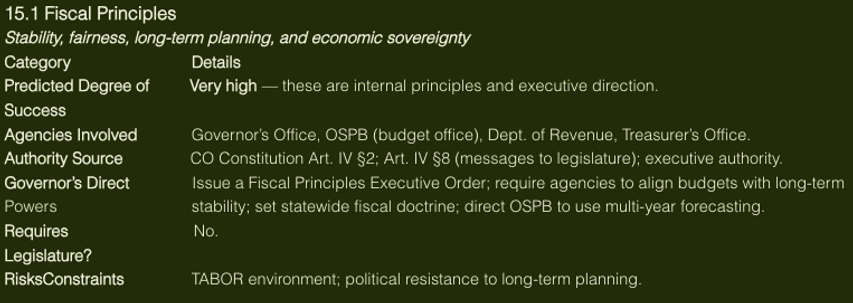


The $840 Million Budget Shortfall
The Plan: Pivot from "cuts" to "Revenue Alignment & Efficiency." Instead of broad-based service cuts, focus on mitigating the impact of the federal One Big Beautiful Bill Act (OBBBA) by decoupling Colorado's tax code from specific federal provisions that drain state revenue.
-
Targeted Action: Accelerate the "Pinnacol Assurance" disaffiliation (privatization) to generate a one-time infusion of roughly $400 million to bridge the immediate gap while implementing long-term "add-backs" for corporate tax deductions (like FDDEI and QBI) to stabilize the General Fund.
-
Authority: Article IV, Section 12 of the Colorado Constitution (Governor’s Budget Message) and C.R.S. § 24-75-201.5, which mandates the Governor to propose and maintain a balanced budget.
-
Agencies: * OSPB (Office of State Planning and Budgeting): To draft the supplemental requests.
-
Department of Revenue (DOR): To implement tax code changes and "add-backs."
-
Medicaid & Healthcare Sustainability
The Plan: Move away from "Hard Caps" to "Modernized Cost Avoidance." Publicly oppose the strict 56-hour caregiving cap and the $3,000 dental cap, which alienate the disability community.
-
Targeted Action: Invest in the Third-Party Liability (TPL) program and upgrade the Medicaid Management Information System (MMIS). By moving from "pay and chase" (recovering money after payment) to "prepayment cost avoidance," the state can save millions by ensuring private insurers or Medicare pay first.
-
Authority: C.R.S. § 25.5-1-104, which grants the Governor authority over the Department of Health Care Policy and Financing (HCPF). Use Executive Order power to direct the focus toward fraud, waste, and abuse (FWA) rather than benefit reductions.
-
Agencies: * HCPF (Department of Health Care Policy and Financing): To manage Medicaid billing and eligibility.
-
CDPHE (Department of Public Health and Environment): For health facility oversight.
-
TABOR (Taxpayer’s Bill of Rights)
The Plan: Propose "TABOR Smoothing" for Essential Services. Since the budget shortfall is driven by a revenue mismatch rather than a lack of tax collection, the "litmus test" strategy is to keep the TABOR refunds but utilize the "De-Brucing" mechanism for specific, voter-approved categories.
-
Targeted Action: Support a ballot measure that allows the state to retain revenue specifically for Mental Health & Fentanyl Treatment that exceeds the TABOR cap, rather than a general "blank check" for the General Fund. This maintains the "spirit of TABOR" while addressing the budget crisis.
-
Authority: Article X, Section 20 of the State Constitution. While the Governor cannot change TABOR unilaterally, they have the Executive Authority to refer measures to the ballot and lead the political coalition for "Refining the Cap."
-
Agencies: * Department of the Treasury: To calculate and manage refund distributions.
-
Department of Local Affairs (DOLA): To manage the impact on local tax assessments.
-
Affordable Housing & Public Safety
The Plan: Execute the "Market-Plus" Strategy. Support the HOME Act for its ability to cut red tape but couple it with a robust "Competency to Case" pipeline for public safety.
-
Targeted Action: * Housing: Use the Governor's authority to fast-track "transit-oriented" development on underutilized state-owned land.
-
Safety: Support the 2026 Fentanyl Initiative’s treatment mandate. Use the Executive Budget to fund $34M for "secure placements" for individuals found "incompetent to proceed" (ITP) in the criminal justice system, moving them out of jails and into treatment.
-
-
Authority: Executive Order (to prioritize state land for housing); Article IV, Section 5 (Supreme Executive Power) to coordinate law enforcement agencies.
-
Agencies: * DOLA (Division of Housing): To administer the HOME Act grants and lot-splitting rules.
-
CDPS (Department of Public Safety): For fentanyl enforcement coordination.
-
CDHS (Department of Human Services): To manage the mental health "Competency" beds and restoration services.
-
This dual-track approach allows you to defend a complex fiscal maneuver (Pinnacol) while positioning yourself as a "Tax Sovereignty" champion who protects the state from federal volatility.
In 2026, Colorado faces a critical fiscal junction. Per the January 2026 budget update, the state is projected to be $308 million below the TABOR cap, meaning no automatic refunds are triggered this year. This creates a strategic window for the administration to deploy OPERATIONS AREA 15 to generate revenue through Enterprises and Service Fees—tools that remain outside the TABOR revenue limit.
The "Enterprise" Strategy: TABOR-Neutral Growth
The most powerful tool for revenue is the Government-Owned Enterprise. Under the Colorado Constitution, an entity that receives less than 10% of its revenue from state/local grants is exempt from TABOR limits.
Priority 2026 Enterprise Launches:
-
The Colorado Infrastructure Bank: Modeled on SB21-260, this enterprise will issue revenue bonds to finance housing and water recycling, charging interest that stays within the enterprise to fund future projects.
-
SkyCarbon Enterprise (CDCO): A new entity to manage the leasing of state land for Direct Air Capture (DACR). Fees from carbon removal companies for land use and "sequestration rights" go directly into a dedicated fund for climate resilience.
-
State Broadband Utility: Leveraging federal "BEAD" grants, Colorado will own mid-mile fiber assets and charge private ISPs "transit fees" for connecting rural communities.
Monetizing State Assets & Lands
The Colorado State Land Board, with 2.8 million acres, is the engine of the "non-tax" revenue model.

Tax Expenditure Reform: The "Hidden" Billions
Colorado loses approximately $5 billion annually to tax expenditures (exemptions, credits, and deductions).
The 2026 Reform Plan:
-
Sunset the "Ineffective": Direct the Office of the State Auditor to rank all corporate tax credits by "Job Creation ROI." Any credit yielding less than $2 in state revenue per $1 spent will be allowed to sunset in 2027.
-
The "High-Earner" Deduction Cap: Following the successful 2025 Proposition MM, the state will continue to cap itemized deductions for households earning over $300,000, redirecting the estimated $95 million annually to universal school meals and snap benefits.
-
Unitary Business Filing: Close the "Loopholes" by requiring corporations to report all income from domestic affiliates, preventing the shifting of profits to low-tax states.
The Colorado Public Investment Fund (CPIF)
The Action: Move from "spending" to "investing."
-
Seeding the Fund: The state will sell $200M in Affordable Housing Tax Credits to institutional investors to create an immediate cash pool.
-
Investment Mandate: The CPIF is authorized to take equity stakes in Colorado-based startups, particularly in the Geothermal and DACR sectors. When these companies go public or are acquired, the state General Fund receives the windfall.

Strategic Narrative: "Economic Sovereignty"
"In 2026, we stop treating Colorado’s budget like a victim of math and start treating it like a portfolio of assets. By modernizing how we lease our land, how we charge for services, and how we invest in our own companies, we are building a state that is self-funded and sovereign. We are not just balancing a budget; we are building a war chest for Colorado’s future."